Content planning is one of those tasks that quietly eats the week. It starts with good intentions, then the team hits the daily question: “What do we post today?” — and suddenly ideas run out exactly when execution is needed most. The pressure is even worse when a small team tries to maintain a cadence that looks like a **Red Bull-level content machine. That kind of consistency is doable, but not with a workflow that depends on last-minute inspiration. What you need is a system that pre-fills the next month with purposeful ideas, repurposes them across channels, and makes publishing routine instead of stressful. That’s the practical promise of a 30-day AI content calendar: remove the daily blank-page problem so your team can focus on quality and iteration. This article explains how a 30-day calendar workflow works, why it’s effective, and how a small team can use it to publish like a bigger one.
Most marketing teams don’t lack strategy. They know what they want: more leads, stronger brand perception, more applicants, more sales, more retention. The stall happens when strategy has to become daily output. Turning a goal into 20–30 posts a month is not “one task.” It’s a pipeline: ideation, writing, formatting for each platform, approval, scheduling, and follow-up. Without a system, that pipeline collapses into reactive posting. People default to whatever is easiest, which usually means generic content that fills a slot but doesn’t serve a purpose. The second problem is context switching. Even if someone has ideas, converting one idea into platform-ready posts across five channels takes time and attention. That’s why small teams feel stuck in an endless cycle: plan a little, scramble a lot, and repeat. The solution isn’t to work harder. It’s to pre-build the pipeline so each day has a clear “next post” ready to go. When execution becomes a routine, consistency becomes sustainable. And consistency is what creates compounding reach and audience trust over time.
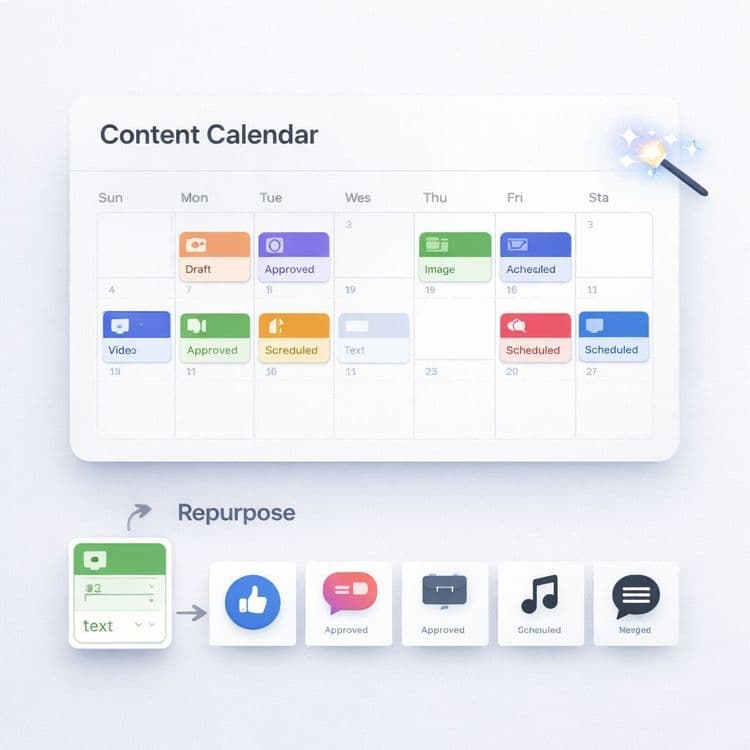
A 30-day content calendar doesn’t have to be a massive project. The point is to compress planning into a single short session and then let the system generate the structure. With ABEV.ai ABEV.ai, the idea is simple: build a 30-day AI content calendar in about 30 minutes. You choose your goal — leads, brand, or hires — and define your audience. The platform generates 30 themes and series aligned to that goal, so the calendar has purpose rather than random variety. That’s an important distinction. A calendar is only valuable if it reduces decision fatigue while staying aligned to outcomes. The system then turns single ideas into multiple executions, which is how big brands achieve consistency. Instead of thinking “we need 30 new ideas,” you think “we need a handful of strong themes, executed repeatedly with smart variation.” This is the same principle that makes media brands powerful: repetition with intent. A monthly calendar becomes a strategic asset rather than a schedule full of placeholders.
The fastest way to scale output without sacrificing quality is repurposing — but only if it’s done natively. Copy-pasting the same text across platforms rarely works because each channel has different expectations and formats. A workflow engine can take one core idea and produce five repurposed versions for Facebook, Instagram, LinkedIn, **TikTok, and Threads Threads. That matters because repurposing should reduce work, not create new work. When versions are generated in the right shape, the marketer’s job becomes editing and aligning, not re-writing from scratch. The platform also creates automatic variations — different hooks, lengths, CTAs, and tone — while keeping a consistent brand voice. Variation is critical because it prevents “calendar content” from becoming stale. It also makes testing natural. You can run small controlled variations and learn what works without turning every post into a full creative project. Over time, this builds a library of effective hooks and structures that you can reuse intentionally.
** The secret to “big brand consistency” isn’t endless new ideas. It’s a system that turns a few strong ideas into many high-quality executions. **
Even a great calendar fails if content doesn’t make it through approvals and out to publishing. That’s why the operational steps matter as much as the ideas. In a workflow-driven setup, you schedule posts and route drafts through team approvals so nothing gets missed. This removes the classic failure mode where content is “planned” but not executed. Scheduling reduces last-minute stress because publishing becomes automatic. Approval routing reduces internal friction because everyone knows who needs to sign off and where the latest version lives. A calendar system also makes handoffs easier. If someone is sick or busy, another team member can pick up a draft with full context. This is how small teams become resilient. They stop relying on one person’s memory and energy. The workflow becomes the source of truth. When your pipeline is reliable, you regain creative capacity because you aren’t constantly firefighting. That’s when teams start making better work, not just more work.
Imagine a small brand that wants the steady presence and energy you associate with **Red Bull, but only has one person managing content. Without a system, that person is forced to choose between quality and consistency. With an AI calendar workflow, they get daily ideas, ready-made repurposed drafts, and scheduled posts, so they can publish consistently without living inside five different tools. Instead of spending mornings deciding what to write, they spend time refining the most important posts and iterating on what’s performing. This is the real value of a calendar: it reduces the mental cost of starting. When the calendar is pre-filled, the marketer can think like an editor, not like a desperate creator. Over a month, the output looks like a content team, even though it’s one operator. That’s not a gimmick. It’s simply what happens when you turn content from a creative emergency into a repeatable system.
A practical build session is short and structured. Choose your goal and your audience so the calendar has direction. Let the system generate 30 themes and series that fit your brand and the outcome you want. Pick one idea and generate five platform versions so you immediately see how repurposing will work. Schedule the posts and set approvers so execution doesn’t break. That’s the core loop. Once you’ve done it once, repeating it becomes easier because your tone, formats, and preferences are already established. And once you have a month of planned content, you can spend the week responding to signals rather than inventing work. That’s when marketing becomes more strategic. You stop being reactive and start being intentional.
A pre-filled calendar changes the emotional texture of your week. You’re no longer waking up to a blank slate. You have direction, drafts, and a plan. That creates consistency, reduces stress, speeds output, and stabilizes brand tone across platforms. It also gives you space for real creativity, because creativity thrives when there’s structure. When structure is missing, creativity turns into pressure. When structure exists, creativity turns into experimentation. If you want a simple test, ask yourself this: how would your week feel if you already knew what you’d publish for the next 30 days? If the answer is “lighter,” you’re exactly the audience for a calendar system.
How would a pre-filled 30-day calendar change your week?
Just sign up and try our trial — you’ll get access to all features for free for 1 company during the trial.