Social media is a must-have for modern businesses, but that doesn't mean it has to be expensive. With a well-structured budget and the right tools, even a small business can achieve big results without exceeding its financial limits.
Here’s how to build a smart social media budget that works for you, not against you.
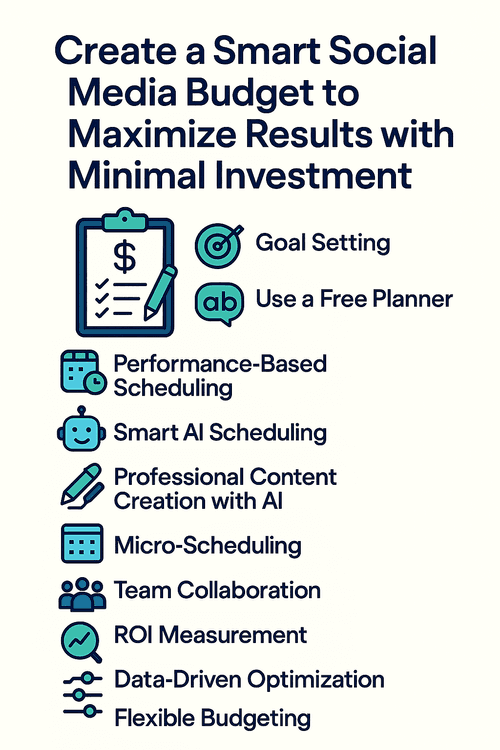
1. Start with goals and performance analysis
Before spending a cent, set clear goals and performance metrics. Use KPI planning to define what you want to achieve – be it follower growth, higher conversion rate, or improved engagement.
2. Use a free planner
At the beginning, you don’t need premium tools. A free post planner helps you build consistency and regularity – the foundation of success.
3. Plan based on performance
Not every post has the same impact. With performance-based scheduling, publish only content that truly delivers. You’ll save time and cut unnecessary content costs.
4. Embrace smart scheduling
Forget guesswork. Advanced planning with AI helps you schedule posts during peak audience activity, increasing reach without boosting costs.
5. Create content like a pro
Use AI tools for design creation to produce professional visuals without hiring a designer. Templates and AI suggestions speed up your work and reduce expenses.
6. Try micro-scheduling
Instead of massive campaigns, go with micro-scheduling – planning short, targeted posts. It’s more budget-friendly and often more effective.
7. Collaborate efficiently
Distribute responsibilities through marketing team collaboration – sharing the workload lowers stress and spreads the costs.
8. Measure ROI carefully
Track what actually brings returns. ROI calculation is crucial to optimize spending – invest only where it pays off.
9. Optimize using real data
AI helps you analyze and adjust content in real time. Platforms like Abev.ai offer predictive content creation and an AI engine for behavioral analysis.
10. Keep your budget flexible and responsive
Your budget should be a living document – adapt it based on performance and feedback. That’s the only way to ensure long-term efficiency.
A smart budget doesn’t mean cutting costs at all costs – it means using every euro with maximum impact. With the right tools, small businesses can get big results from small investments.