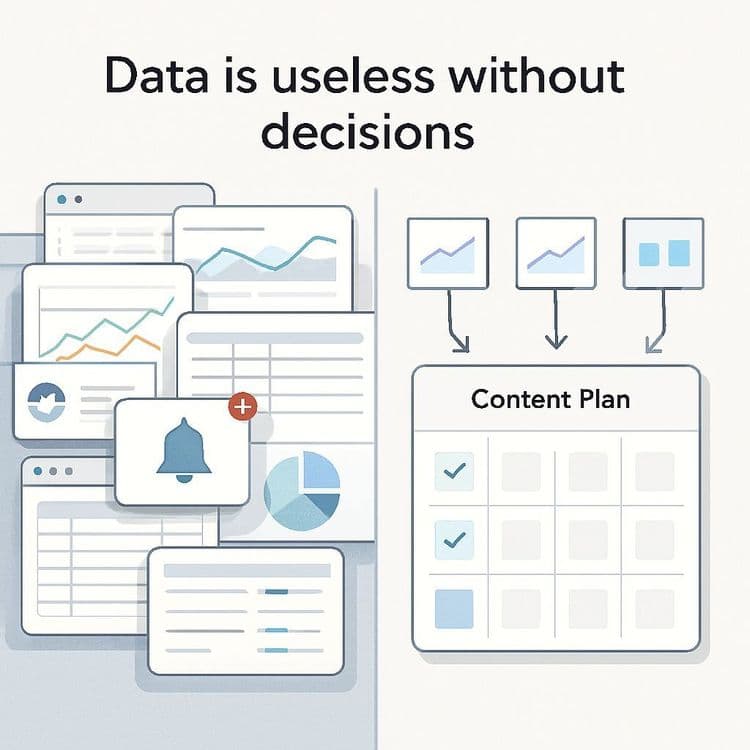
Most teams today don’t suffer from a lack of data. They have attribution models, engagement heatmaps, weekly performance decks, cohort trends, and plenty of dashboards telling them what happened. Yet when Monday comes and someone asks, “What should we post next?”, the room still feels like a guess. That gap isn’t because people are careless or “not analytical enough.” It’s because metrics are outputs, not instructions. Data can point to patterns, but it won’t automatically turn those patterns into a decision, a draft, an approval, and a published post. When the feedback loop is broken, you get content that’s consistent in volume but inconsistent in purpose. And the team ends up doing more reporting than improving.
A dashboard is great at telling you what happened, but it rarely tells you what to do. The reason is simple: most metrics are descriptive, not prescriptive. “Engagement went up” doesn’t tell you which message element caused it, which audience segment mattered, or whether it aligned with your business goal. “CTR dropped” doesn’t tell you if the hook failed, if the creative was off, if the offer was weaker, or if timing was wrong. Teams often treat data like it’s self-explanatory, then wonder why decisions don’t get easier. In reality, the missing layer is interpretation: what the metric implies, what hypothesis it supports, and what action it suggests. Without that layer, teams default to safe patterns: post more, test something, tweak the headline, change the time. Those actions can help, but they become noisy when they aren’t tied to a clear goal per post. That’s why you see A/B tests that start and never really finish, because no one knows what “winning” means beyond a vague uplift. It’s also why reporting meetings grow, because people are trying to translate numbers into direction in real time. The paradox is painful: more visibility, less clarity. Until you connect metrics to decisions inside the workflow, dashboards will keep producing insights that never become execution.
In most organizations, analytics and execution live in different places. Insights sit in one tool, planning sits in another, drafts live in docs, approvals happen in email or chat, and publishing happens somewhere else entirely. Every time work jumps to a new tool, context leaks. The person creating the post doesn’t always know which KPI matters most this week, or which recent content pattern is worth repeating. The approver doesn’t always see the performance context, so feedback becomes subjective rather than goal-driven. The scheduler doesn’t always know what the post is trying to achieve, so timing choices become random. This is where even strong teams get stuck: they can describe performance perfectly, but they can’t operationalize it quickly. It’s not because they don’t care. It’s because the system doesn’t make “insight to action” the default path. Meanwhile, companies like Google and Meta win at scale not because they have more numbers, but because they bake learning into repeatable cycles. Goals, experiments, creative production, and iteration are connected, so improvement becomes a habit, not a special project. When marketing teams don’t have that loop, they compensate with more meetings. They compensate with more dashboards. They compensate with more “content volume.” But none of those fixes the underlying break: the handoff between learning and publishing.
** If your workflow can’t turn last week’s results into next week’s plan, your team will keep “measuring” progress while moving at the same speed. **
The practical gap is what ABEV.ai is designed to close: linking performance signals to content choices, inside one connected loop. The goal isn’t another analytics dashboard. The goal is a workflow where every post has a declared intent before it’s written, so performance can be judged against purpose. In a loop like that, the system helps you clarify whether a post is meant to drive awareness, clicks, lead quality, retention, or trust, and then keeps that context visible through drafting and approvals. It also surfaces recent posts that are obvious candidates for republishing, refreshing, or creating a variant, so the team doesn’t start from zero every time. That matters because most teams already have winners, they just don’t reuse them systematically. Approvals move faster when reviewers can see the goal and the performance context, because feedback becomes “Does this serve the purpose?” instead of “Do I personally like this?” Scheduling becomes smarter because posting cadence ties back to what worked, not to habit. Finally, results feed back into planning automatically, so next week’s calendar reflects reality, not preferences. This isn’t marketing magic. It’s systems thinking: structure the work so decisions are traceable and repeatable. When that loop exists, your data starts changing what you publish tomorrow, not just what you report today.