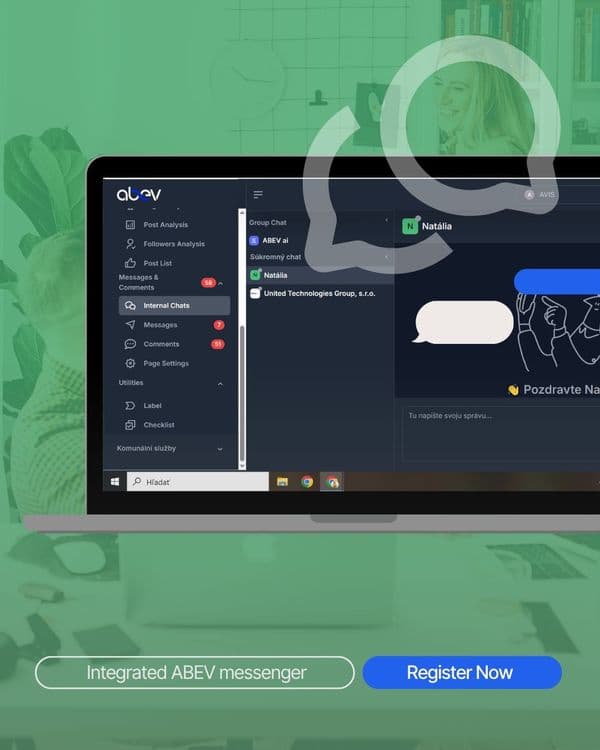
Content production isn’t just writing and posting—it’s a workflow. Tasks need owners, deadlines need clarity, feedback needs to land in the right place, and the whole team needs to stay aligned without constant meetings. When tasks live in one tool, chat in another, and approvals in a third, productivity quietly bleeds out through confusion and rework. An internal messenger inside your content platform flips that: you manage tasks, chat, and share feedback instantly—right where the work happens. That’s how teams stay connected, move faster, and ship higher-quality content with less friction.
Most teams don’t lack communication. They have too much of it, spread across too many places. A single post might generate:
a Slack thread with feedback,
a Google Doc with edits,
an email approval chain,
and a spreadsheet update to “mark it done.”
That fragmentation creates predictable issues: decisions get lost, the latest version is unclear, and people end up repeating the same questions. It also makes it harder to onboard new teammates because the “why” behind decisions is scattered.
If you’ve ever managed a fast content cycle, you know the pain: the work isn’t hard—the coordination is.
External chat apps are great for general team communication. But for content workflows, they’re missing one crucial thing: context attached to the task or post. Without that, chat becomes a river of messages that you constantly have to interpret and reconnect to the actual work.
Internal messaging inside a platform like ABEV is different because:
the conversation stays linked to the content or task,
feedback sits next to the caption, asset, and schedule date,
and decisions are easier to track later.
Instead of “Where are we on that post?” you see it immediately—status, comments, and next steps included.
When messaging is integrated with task management, it stops being “talk” and starts being execution. You can:
assign a task and immediately clarify expectations,
ask a question and get an answer in the same context,
share feedback without rewriting it in another tool,
and move a post forward without waiting for a meeting.
This is the backbone of productive teams: fewer handoffs, fewer blind spots, and fewer “I thought you were doing it” moments.
A lot of global brands operate this way internally—think Bosch or IKEA—not because they love tools, but because consistent execution requires tight coordination. The smaller the team, the more you feel the cost of wasted time.
Internal messaging keeps the work and the discussion in the same place—so you don’t lose time searching for the latest file, the latest decision, or the latest feedback. When you remove that friction, your team ships faster, makes fewer mistakes, and stays focused on content quality instead of coordination.
Fast feedback isn’t just about speed—it’s about quality. When reviews take days, people forget context, and drafts get worse through rushed last-minute edits. When feedback is instant and visible, you get:
clearer revisions,
faster approvals,
fewer misunderstandings,
and a smoother creative rhythm.
It also encourages better collaboration habits. People are more likely to leave actionable feedback when it’s easy and contextual—rather than dropping a vague “can we improve this?” message somewhere else.
You’ll feel the biggest impact if you:
run multiple clients or brands,
coordinate approvals with managers or stakeholders,
publish frequently across platforms,
work remotely or async,
or regularly shift schedules due to campaigns and priorities.
In these environments, internal messaging isn’t a “nice to have.” It’s the glue that keeps output consistent without increasing meetings.
You don’t need to overhaul everything in one day. Start with a simple rule:
feedback on posts happens inside the platform,
task updates happen inside the platform,
approvals happen inside the platform.
Keep Slack for general team chatter if you want—but move content execution into one place. Within a week, you’ll notice fewer duplicated messages, fewer missed updates, and fewer errors caused by outdated versions.