Native analytics are convenient right up until they stop being reliable. One day a metric definition changes, the next day a metric disappears, and suddenly teams are reporting what’s available rather than what’s true. The problem isn’t that platform dashboards are “bad.” It’s that they’re built for each platform’s internal logic, not for cross-channel decision-making. If you manage multiple networks, you’ve probably felt the drift: inconsistent definitions, shifting labels, missing history, and a reporting process that breaks at the worst time. At small scale, it’s annoying. At high scale, it becomes operational risk. This is why mature teams eventually move from platform-native metrics to API-driven collection and normalized, custom KPIs. They’re not chasing more data. They’re chasing a single truth they can act on.
Every platform evolves its product, and analytics often change as a side effect. Definitions get tweaked, features get sunset, and reporting endpoints get altered or deprecated. That’s normal for platforms, but it’s painful for teams trying to measure performance consistently over time. It’s especially painful across networks because each platform measures engagement, reach, video views, and response behavior differently. Even something as basic as “engagement rate” can mean different things depending on what counts as engagement and what the denominator is. Teams often don’t notice the drift until someone compares reports month over month and the story suddenly stops making sense. At that point, you’re not analyzing performance. You’re debating what the metric even means. And that debate slows decisions.
The second problem is fragmentation. Most teams collect metrics in five different places, then manually reconcile them in a report. That introduces human error and encourages shallow analysis because the work is exhausting. When reporting becomes heavy, teams reduce it to what’s easy: totals, snapshots, and platform screenshots. This is how “dashboard culture” turns into “reporting theater.” You’re busy, but you’re not getting clearer. The biggest casualty is consistency. If metrics aren’t stable and comparable, you can’t confidently answer: did we improve, or did the definition change?
At scale, metric drift becomes more than a reporting nuisance. Think brands with **McDonald's-level volume: high posting frequency, constant campaigns, and customer conversations happening in public comments and DMs. When analytics are inconsistent, teams can’t reliably compare performance across channels or prove improvement over time. An agency can be mid-report when a key metric vanishes or gets redefined. A customer-care team can’t compare average response time across channels because each platform reports it differently or not at all. A leadership team can’t set a meaningful SLA target if there’s no unified baseline. In that environment, reporting gaps don’t just reduce insight, they reduce control.
This also impacts planning and staffing. If you can’t measure response time consistently across platforms, you can’t staff support properly. If you can’t measure comment-to-reply ratio reliably, you can’t tell whether community management is keeping up. If you can’t unify engagement rate by your definition, you end up optimizing toward whatever a platform happens to expose today. That is the opposite of operational maturity. Mature teams define their KPIs first, then compute them consistently, regardless of which platform is having a metrics identity crisis this month.
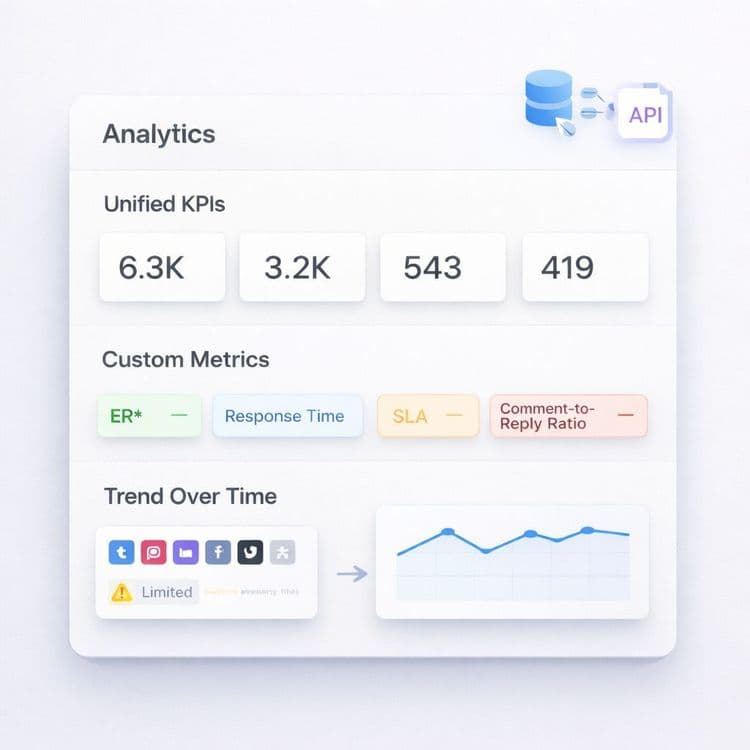
This is the practical gap **ABEV.ai is built to fill: API-driven collection plus database-calculated custom metrics. The core idea is straightforward. Instead of relying on platform dashboards, data is pulled through APIs and normalized so **Facebook, **Instagram, **LinkedIn, **TikTok, and **Threads sit on the same footing. Once the data is normalized, you compute the KPIs you actually care about in one place, with one definition, across all channels. That’s the difference between “more numbers” and “better measurement.”
** API collection plus custom metrics isn’t about adding complexity. It’s about removing ambiguity so decisions are based on consistent evidence, not fragmented platform outputs. **
Normalization matters because it creates fair comparisons. If one platform counts a view differently and another platform changes a reach metric, your unified layer still maintains continuity because your reporting logic is controlled on your side. That means you can compare channels without constantly caveating the report. It also means history stays usable. When metrics drift on the platform, you can preserve continuity in your own dataset and calculations. In practice, this creates a stable foundation for decision-making: you can spot trends, measure improvements, and catch early warning signals before they become problems.
Custom metrics are only useful if they map to real operational questions. The most valuable ones tend to be the KPIs that platform dashboards either don’t provide or don’t provide consistently. Engagement rate is a common example because teams often want their own definition: maybe you want engagements divided by impressions, or divided by reach, or weighted by meaningful interactions. Response time is another, especially if you want a true cross-network average for your support SLAs. Comment-to-reply ratio can show whether community management is keeping up with volume, which is critical during campaign spikes. SLA hit rate is a leadership-friendly metric because it ties response performance directly to a clear threshold. Trend indexes help teams see whether performance is improving relative to baseline instead of reacting to week-to-week noise. Positive/negative ratios can help prioritize escalation when sentiment shifts.
The practical outcome is a dashboard that behaves like a control panel rather than a scrapbook. You’re not collecting metrics because they exist. You’re computing them because they answer the questions that determine next actions. And because those metrics are computed consistently, you can compare channels side by side without the usual “but Facebook reports this differently” footnote. That reduces internal debate and speeds decisions.
When you rely entirely on native dashboards, you accept surprise as normal. The most common surprise is reporting instability: an agency prepares a monthly deck and discovers a key metric changed or disappeared mid-review. Another surprise is measurement mismatch: a support manager tries to improve response time but has no reliable cross-network baseline to prove progress. Another is leadership confusion: trends don’t match expectations because the underlying definitions shifted. Each of these situations wastes time and creates doubt. Doubt is expensive because it slows action, and when action slows, performance usually drifts downward.
A unified measurement layer avoids these traps by maintaining historical continuity, controlling KPI definitions, and alerting teams when something changes. Automated alerts matter because teams shouldn’t have to discover KPI degradation at the end of the month. If a source changes, or a KPI dips below a threshold, the workflow should surface it early. That is how analytics becomes operational instead of retrospective. Instead of “what happened,” you get “what’s changing and what should we do next.”
The result of API-driven collection plus custom metrics is not just cleaner reporting. It’s fewer surprises, faster alignment, and decisions that are easier to defend. When KPIs are computed consistently, teams stop arguing about the numbers and start improving the work. When you have multi-platform views built on unified definitions, you can allocate effort and budget more confidently. When you track response and moderation KPIs across channels, customer experience stops being anecdotal. And when alerts catch drift early, you fix problems before they show up in a quarterly review.
How do you handle metric drift across platforms today?
Just sign up at www.abev.ai and try our trial. You’ll get access to all features for free for 1 company during the trial.