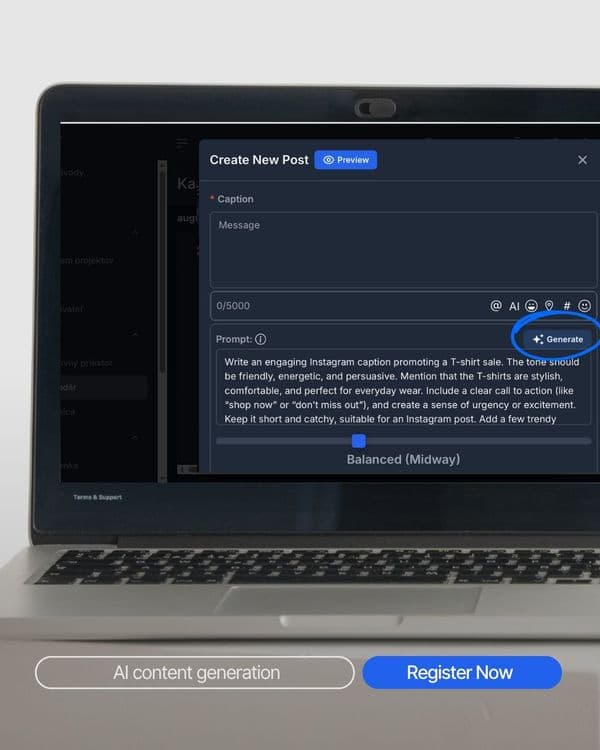
Writing captions sounds easy until you have to do it consistently, across platforms, while staying on-brand and not repeating yourself. Some days you’re inspired. Other days you’re staring at a blank box thinking, “How do I say this without sounding like everyone else?” That’s where AI caption generation becomes genuinely practical—when it turns a short prompt into multiple strong options that already match your tone of voice. Instead of one draft you have to rescue, you get three different directions instantly, pick the best, copy-paste, and move on. And if you want to refine it, you can—fast. The goal isn’t to replace your voice. It’s to remove the friction between idea and publish.
The biggest time drain in caption writing isn’t typing—it’s deciding. You rewrite the hook five times, you switch between “professional” and “casual,” you second-guess the CTA, and then you lose momentum.
Multiple versions solve that immediately because they give you:
different angles (educational, bold, conversational),
different lengths (short punchy vs. structured),
different CTAs (soft invite vs. direct action),
and often a better first line than the one you would’ve forced out.
This is how good copy teams work in real life: they don’t write one option, they write several and choose the strongest. AI just compresses that process from 30 minutes into 30 seconds.
Generic AI captions are easy to spot. They sound polished but empty, full of filler phrases and the same tired structure. The difference between “AI spam” and “AI as a tool” is tone-of-voice alignment.
When your brand voice is consistent, your content becomes recognizable—like how IKEA feels calm, practical, and human, or how McDonald’s keeps it playful, simple, and instantly on-brand. That consistency doesn’t happen by accident. It happens through rules: vocabulary, sentence rhythm, emojis (or none), directness, humor level, and the type of CTA you use.
When AI is trained or guided with those rules, it stops generating random captions and starts generating options that sound like you.
A “great prompt” isn’t long—it’s clear. If you want high-quality output, give the AI enough context to make smart decisions. The best prompts usually include:
What you’re posting about (feature, offer, story, tip, update)
Who it’s for (marketers, founders, HR, e-commerce teams, etc.)
What the audience should feel or do (trust, curiosity, click, comment, register)
Tone of voice (confident, friendly, sharp, premium, witty, no fluff)
Platform (LinkedIn vs Instagram changes structure and style)
Optional constraints (length, emojis, hashtags, CTA style)
Even one extra sentence can make a big difference, like: “Write it in a straightforward, slightly witty tone. No hype. One clear CTA.”
AI caption generation works best when you treat it like a copy partner, not a vending machine. Generate three versions, pick the strongest direction, then fine-tune the hook, one key sentence, and the CTA. That 2-minute polish is what turns “good” into “on-brand and conversion-ready.”
This also solves the common fear: “AI will make us sound the same.” It won’t—if your team owns the final edit and keeps a consistent voice.
Most of the time, you don’t need to rewrite the whole caption. You just tweak the parts that matter:
sharpen the first line (hook),
replace one generic sentence with a specific example,
adjust the CTA to match your current funnel,
add a line that sounds unmistakably like your brand.
This is where your expertise stays in control. AI gives you speed and options. You provide taste and strategy.
Consistency is the hardest part of content. Not because teams don’t care, but because caption writing is a repetitive task that consumes creative energy you’d rather spend on campaigns, positioning, and offers.
When you can generate on-brand options instantly:
you ship more without lowering quality,
you maintain a consistent tone across the team,
you reduce the “blank page” friction,
and you keep momentum even on busy weeks.
For small teams especially, this is a multiplier. You don’t need a bigger team—you need a smoother workflow.
Use this structure as a starting point:
“Write 3 caption variations for a post about [topic] for [audience]. Tone: [tone rules]. Goal: [action/feeling]. Keep it [length]. Include [CTA style]. Avoid: [things you don’t want].”
Example (B2B LinkedIn):
“Write 3 LinkedIn caption variations about repurposing high-performing posts. Audience: marketing teams at SaaS companies. Tone: confident, practical, no hype. Goal: drive free trial sign-ups. Length: 600–900 characters. CTA: ‘Try it free.’ Avoid clichés and generic AI phrasing.”