Comments can feel like the Wild West. Spam, hate, scam links, toxic threads — and genuine customer questions all mixed into the same feed. When that chaos is left unchecked, it doesn’t just look messy. It can damage reputation, frustrate customers, demotivate the team, and lower the overall quality of discussion in ways that quietly hurt reach and engagement. The operational risk is real: harmful content spreads faster than your team can react, while legitimate questions get buried and go unanswered. That creates the worst combination: public negativity plus poor customer experience. Moderation isn’t a “nice to have” anymore. It’s a workflow problem that needs a system, especially when content volume grows across multiple channels. This article explains a practical, rule-based approach to comment moderation and how automation can reduce noise while keeping high-risk decisions in human hands.
Most teams think of moderation as a reputation issue, but it’s also a performance issue. When a comment section fills with spam, scams, or toxic back-and-forth, real customers hesitate to engage. That lowers meaningful interaction and can reduce the quality signals platforms use when distributing posts. It also creates “attention debt” for the team: staff spend time cleaning up obvious junk instead of answering questions that lead to revenue or retention. Toxic threads have a second-order effect too. They demotivate community managers and make brands less willing to post consistently because every post becomes a potential crisis. Over time, that fear creates silence, and silence kills momentum. In e-commerce, this is amplified because comment sections often become a support channel: shipping questions, product questions, return concerns. If those questions are buried, customers get frustrated. And frustration doesn’t stay private — it becomes visible to every new viewer. The same is true for clinics and professional services, where anxious clients interpret slow responses as lack of care. A messy comment section isn’t just “bad vibes.” It’s operational drag, reputational risk, and lost opportunity rolled into one. The solution is not to respond to everything manually. The solution is to triage what matters and escalate risk intelligently.
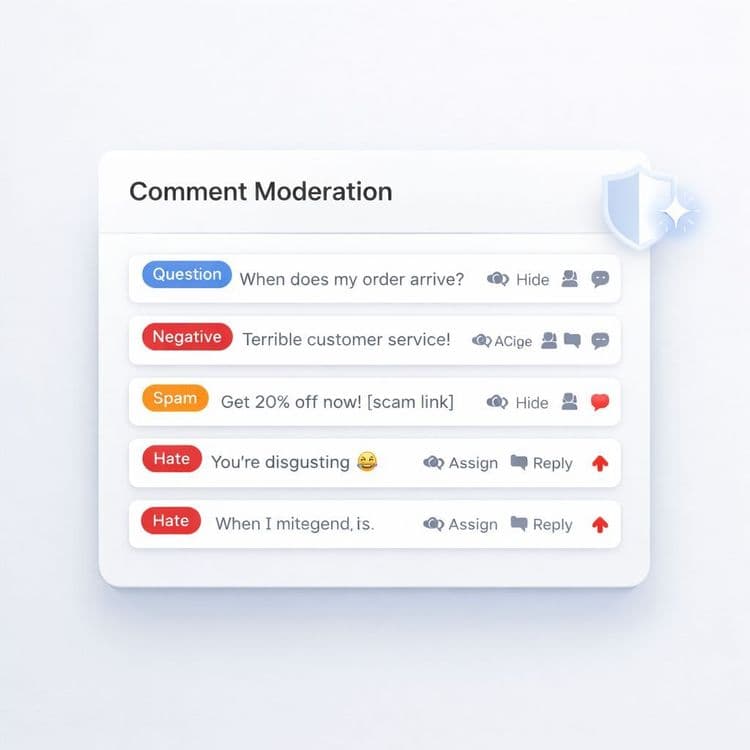
Manual moderation relies on a fragile assumption: someone is always watching. In reality, volume spikes, people are busy, and toxic content often arrives at the worst times. A rule-based system is more reliable because it doesn’t depend on constant attention. ABEV.ai ABEV.ai approaches moderation as triage first, response second. Incoming comments are categorized into practical buckets such as question, complaint, spam, or hate, then sentiment scoring is applied to surface negative or crisis threads for human review. That changes the workload. Instead of scanning everything, the team focuses on the threads that actually require judgment. For routine items, the system suggests brand-aligned reply drafts and reusable templates, so responses stay consistent and fast. The important shift is that the system doesn’t “decide” the brand’s stance. It simply reduces noise and provides structured assistance where the response is straightforward. When the team starts from a strong suggested draft, they can spend time on nuance where it matters. That’s how you scale moderation without turning every post into a stressful monitoring exercise.
A moderation system needs specific controls to be useful. Automated triage and sentiment labeling are the foundation, because they tell you what you’re dealing with at a glance. Immediate escalation of negative or crisis threads is essential, because speed is part of risk management. Reply suggestions in brand tone help maintain consistency, especially when multiple people respond across shifts. Reply templates reduce effort further and prevent “reinventing” common responses. Configurable rules to hide, flag, or assign comments to teammates add operational flexibility, because every brand has different thresholds. Some will hide spam instantly, some will flag it for review, and some will assign it to customer support. The more predictable your workflow becomes, the less panic your team feels when volume spikes. Predictability also improves quality, because people respond better when they’re not overwhelmed. Over time, these controls become a governance layer: the brand’s boundaries are enforced consistently, regardless of who is on shift. That consistency is exactly what buyers associate with mature brands. When moderation becomes a system, it stops being a daily gamble.
** The goal isn’t to “respond faster to everything.” The goal is to separate noise from signal so humans spend their attention on what only humans can handle. **
Imagine a TikTok TikTok post where a sudden wave of hateful replies appears at the same time scam links push fake checkout pages. A system can block or hide obvious spam patterns, flag the hate thread for escalation, and queue a human to handle the nuanced response. That matters because hate and scams are not equal risks. Scam links demand immediate suppression to protect customers. Hate threads demand judgment and brand policy alignment, because the “right” response depends on context. Now picture a Facebook Facebook post where several customers ask, “When will my order arrive?” while spam floods the comments. Without triage, agents waste time wading through junk and customers wait longer. With triage, genuine questions are separated and surfaced to customer support, while noise is hidden or flagged automatically. That reduces time-to-resolution and improves the public perception of service. These scenarios aren’t edge cases anymore. They’re normal operating conditions for many brands. The difference between chaos and control is whether your team is reacting manually or operating with a structured triage layer.
The most important part of comment automation is knowing where it should not act. Critical guardrails should be built in: never auto-respond to sensitive topics, always hand off potential crises to a human, and keep escalation paths simple so nothing slips through. “Sensitive” can include issues related to legal risk, medical topics, harassment, discrimination, threats, or anything that could escalate reputationally. A safe system doesn’t try to “win arguments.” It prioritizes containment, escalation, and consistent handling. Automation is excellent at recognizing patterns, categorizing, and routing. Humans are necessary for intent interpretation, empathy, and policy decisions. The best moderation workflows respect that division. They don’t aim for maximum automation. They aim for maximum reliability. When guardrails are strong, teams trust the system and use it more, which improves outcomes. When guardrails are weak, teams fear automation and revert to manual work, which collapses under volume. The goal is a system that makes the safe choice the default choice.
When moderation runs as a workflow, comment sections become more useful again. Spam and scams are reduced, toxic threads are handled faster, and genuine questions are surfaced and answered. That improves customer experience because people feel seen. It improves brand reputation because your pages feel actively managed and safe. It improves team morale because community managers aren’t drowning in junk. And it can improve performance because healthier discussion often leads to better engagement quality. Moderation isn’t about censorship; it’s about maintaining a functional conversation space where customers can ask questions without being drowned out by bad actors. If you’re currently triaging comment volume manually, you’re spending valuable human attention on work that a system can handle more reliably. A practical triage layer gives you speed where speed is safe, and escalation where judgment is needed.
How are you currently triaging comment volume and risk in your social feeds?
Just sign up at www.abev.ai and try our trial — you’ll get access to all features for free for 1 company during the trial.