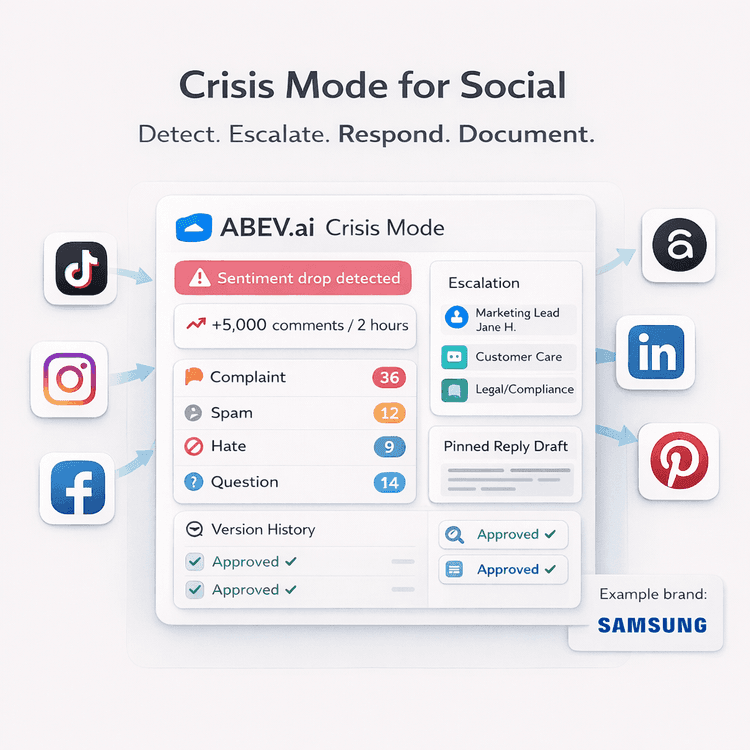
A “social media crisis” rarely starts with a press release. It starts with a sudden spike: comments multiply, sentiment drops, scam links appear, and the team realizes they’re trying to manage a live situation through scattered tabs and screenshots. In that moment, the biggest risk isn’t that you say the wrong thing. It’s that you respond too slowly, lose ownership of the thread, or miss the few messages that actually matter. That’s why crisis response is less of a PR skill and more of an operational system. Brands that recover fast usually have a workflow that detects issues early, routes them to the right owners, and keeps decisions traceable. Brands that struggle tend to improvise, which creates delays, confusion, and inconsistent tone. The goal of Crisis Mode isn’t perfection, it’s control under pressure.
The internet rewards speed, but organizations reward process, and that mismatch is where crises grow. When a post starts trending for the wrong reason, you don’t have time to schedule a meeting just to find out who owns the response. You also don’t have time to rebuild context from scratch, especially when different stakeholders are watching the situation from different angles. The reality is that comment spikes are not evenly distributed, because most of the volume is noise mixed with a small number of high-impact signals. If your team is reading everything manually, they will burn time on spam while missing the real customer complaint that needs escalation. If your team is responding too quickly without coordination, you risk tone drift and inconsistent statements that invite more scrutiny. Most brands also underestimate how cross-platform crises behave, because the same incident spreads differently on **TikTok, **Instagram, **Facebook, **LinkedIn, and **Threads. What looks like “one thread” to a customer can be five parallel threads internally, each with different volume and different risk. That’s why “watching notifications” is not a strategy, it’s a gamble. Operationally mature teams treat spikes like incidents: detect, triage, assign, respond, document. When those steps are explicit, the team can move quickly without guessing what comes next. And when the steps are implicit, every decision becomes slower because people are debating the process while the situation evolves.
A functional crisis workflow starts with detection that doesn’t rely on someone being online at the right moment. If comment volume jumps or sentiment shifts sharply negative, the system should surface it as an alert instead of waiting for a human to notice. The next step is triage, because raw volume is not the same as real risk. Categorizing comments into buckets like questions, complaints, spam, or hate helps your team focus attention on what can escalate and what can be suppressed. Ownership matters immediately after that, because “everyone watching” often turns into “nobody acting.” Clear assignment routes the thread to the right person, while also looping in roles that need awareness, like customer care and compliance. Response drafting should be structured so the team can publish quickly without improvising from zero. A pinned reply draft and a short playbook for common incident types can buy time while you investigate facts. Approval routing is the difference between fast and reckless, because it keeps the message aligned while still moving quickly. Version history is critical, because during incidents the story changes, and you need to know what was approved and why. **ABEV.ai treats this as a connected system rather than a set of separate tasks, so context stays attached to the incident instead of being scattered across channels. Most importantly, safe automation should know when to stop, because not every situation should trigger auto-replies. A well-designed workflow prioritizes escalation for sensitive topics, while still removing obvious noise like repeated spam patterns. The result is a response process that feels controlled, even when the volume doesn’t.
** The brands that handle spikes well aren’t “better at PR.” They’re better at owning the workflow: who acts first, what gets prioritized, what gets approved, and what gets documented while the thread is still moving. **
Speed becomes safer when decisions are constrained by rules instead of personal judgment under stress. That means defining escalation triggers in advance, such as sharp sentiment drops, threat keywords, scam-link patterns, or sudden comment velocity. It also means defining who gets pulled in automatically, so the team doesn’t waste time figuring out the chain of command while the thread grows. A good workflow makes it easy to pause risky automation during an incident, so the team doesn’t accidentally reply to sensitive content with a generic message. It keeps response drafts brand-aligned, but still editable, because local context and nuance are human work. It also keeps the record clean, because later you will need to explain what happened internally, and memory will be unreliable. This is where audit trails and version history become practical, not bureaucratic, because they reduce second-guessing and blame. The workflow should also make it easy to separate crisis response from routine customer support, so agents can keep answering real questions while a smaller group handles the incident thread. Over time, teams become less reactive because they’ve turned incidents into a repeatable process instead of an emotional fire drill. Even as a thought exercise, imagine a large brand like **Samsung facing a sudden product-issue thread: the difference between a messy response and a controlled response is often measured in minutes, not days. Controlled minutes come from preparation, not heroics. When preparation is built into the system, teams can act quickly while still protecting brand and legal boundaries. That’s what “Crisis Mode” really means: operational readiness that shows up when the internet gets loud.
Start by stress-testing your current workflow, not your copywriting skill. Ask whether you can detect a spike quickly without relying on one person’s notifications. Ask whether you can categorize inbound volume so spam doesn’t bury genuine complaints. Ask whether ownership is obvious the moment something escalates, including who handles public replies versus private follow-up. Ask whether you have pre-approved response templates for common situations, so you can buy time without sounding evasive. Ask whether approvals are fast but traceable, so you can move quickly without losing governance. Ask whether you can pause automation instantly when a topic becomes sensitive. Ask whether your team can see the full context in one place rather than rebuilding it from screenshots and forwarded messages. Ask whether you can document decisions in real time, because after the incident, you’ll want to learn from it. Then run one tabletop scenario: “5,000 comments in two hours,” and map who does what in the first fifteen minutes. You don’t need a crisis to practice readiness, and practicing readiness is what prevents small spikes from becoming big reputational events.