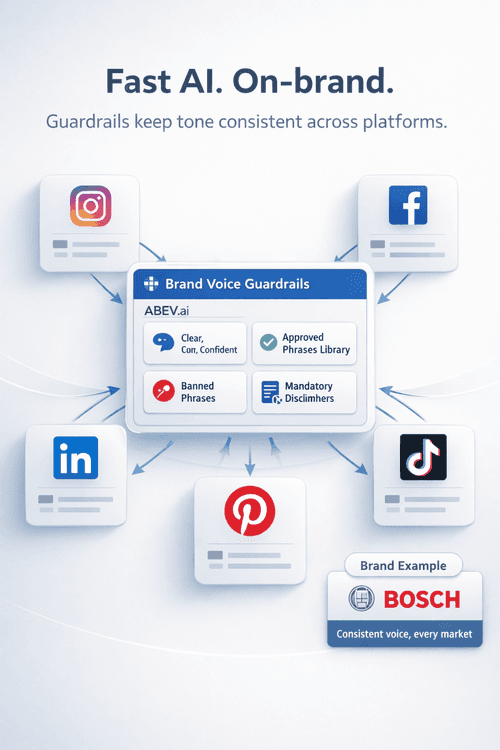
Off-brand is the real AI risk — not typos, but tone that drifts and slowly erodes trust. When teams adopt AI for content at scale, the upside is obvious: faster output, more variations, more channels covered with less effort. The downside is quieter and more dangerous. Unchecked AI output can introduce inconsistent messaging, regulatory slips, and a brand voice that gradually becomes “generic.” Audiences might not notice the first time, but they notice the pattern. And in B2B, professional services, or regulated categories, tone drift is often interpreted as lack of credibility. That’s why the goal isn’t “AI writes everything.” The goal is “AI writes quickly inside boundaries.” Guardrails are what make that possible.
A system like ABEV.ai ABEV.ai treats guardrails as part of operations, not as a separate brand PDF nobody reads. You encode voice, legal requirements, and reusable, approved claims so teams move fast without losing control. The result is platform-native volume with predictable quality and clear auditability — meaning you can scale content without scaling risk.
Most teams worry about obvious errors: wrong product names, grammar, awkward phrasing. Those problems are fixable and easy to catch. Tone drift is harder because it rarely looks “wrong” in a single post. It shows up across weeks: slightly more hype, slightly less precision, more vague claims, a different cadence, an inconsistent CTA style. Over time, your brand starts sounding like everyone else. That erodes trust, and trust is one of the only assets marketing can’t buy back quickly. The risk increases when content production scales across multiple people, multiple markets, and multiple platforms. Without guardrails, each output becomes a new interpretation of the brand. With guardrails, the system protects consistency while still allowing humans to refine nuance. That’s the healthy model: automation does the repeatable work; people do judgment.
Guardrails are not “restrictions” in the negative sense. They’re a framework that makes speed safe. In practice, they usually include four layers: a brand voice profile, an approved phrases library, a banned phrases list, and mandatory elements tied to post types and compliance.
A useful voice profile is short and operational. It’s not a long manifesto. It’s a few voice words and a handful of do’s and don’ts that prevent the most common drift. For example:
Voice words: clear, confident, helpful, precise
Do: prioritize facts and measurable benefits; cite sources when relevant.
Do: keep sentences concise and structured.
Don’t: use slang or humor that undermines authority.
Don’t: overpromise or exaggerate.
This profile becomes a constraint the AI follows when generating drafts, and it becomes a reference point for reviewers. Instead of subjective feedback like “make it more professional,” you have rules that can be applied consistently.
The fastest way to maintain consistency is to reuse vetted language intentionally. An approved phrases library is a set of short snippets that are already compliance-reviewed and on-brand. Examples might include:
“engineered for reliability”
“backed by industry-standard testing”
“learn more about our specs”
These snippets can be inserted where appropriate, which reduces the chance of accidental risky phrasing. It also speeds up writing, because the team isn’t reinventing the same value statements every week.
AI often leans toward generic marketing language unless you block it. A banned phrases list protects against the most common risk patterns:
hype-heavy phrases like “best ever”
absolute guarantees like “will always”
disparaging competitor language
This is especially important in regulated categories and professional contexts where absolute claims can create legal or reputational exposure. Banning certain patterns keeps content grounded and credible.
Guardrails become truly powerful when they connect to workflow. Certain post types require disclaimers or regulatory text, and those elements should be appended automatically rather than relying on memory. At the same time, content still needs to be platform-native:
Instagram Instagram: short and visual
Facebook Facebook: more detailed and community-friendly
LinkedIn LinkedIn: professional and concise
TikTok TikTok: hook + CTA, punchy structure
Pinterest Pinterest: keyword-friendly phrasing
The key is doing this without tone drift. The system generates variants that match platform conventions while staying inside your voice profile and phrase constraints. Then approvals and version history keep everything auditable: every draft, every edit, and every approver note is captured and visible. That’s how you scale without losing control — not by trusting blindly, but by building an enforceable process.
** Guardrails don’t slow teams down. They stop teams from reworking drafts and fixing risk after the fact — which is the slowest, most expensive way to operate. **
For a reliability-first example brand like **Bosch (used here only as an illustration), guardrails would push messaging toward evidence-based phrasing and required technical notes. That matters because reliability claims carry expectations. Guardrails prevent tone inflation (“best,” “always,” “guaranteed”) and keep the language anchored in what can be supported. They also help maintain consistency across markets, including Slovakia, because the same voice profile and approved claims apply everywhere. Local teams can still adapt culturally, but the core standards stay intact. The output feels consistent not because it’s repetitive, but because it’s governed.
If you want the speed benefits of AI without the risks of tone drift, you need guardrails that live inside your workflow, not in a forgotten document. ABEV.ai ABEV.ai is built to help teams generate platform-native content at scale while preserving brand voice, compliance requirements, and clear approvals.
Sign up on abev.ai and try the free trial (all features for 1 company).