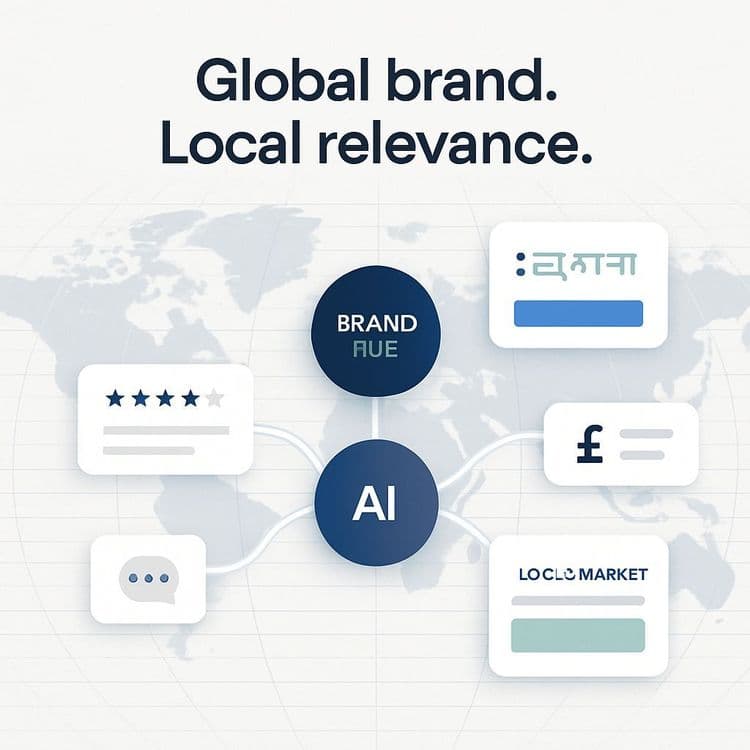
When you manage marketing across multiple countries, the tension is familiar. Global brand rules keep things safe and consistent, but local teams need enough freedom to make messages feel relevant. Too often, the compromise is a slow, fragmented process: the central team ships a campaign, regions scramble for variants, approvals pile up, and by the time localized posts go live, the moment has passed. The content that does publish can end up sounding generic, because it was shaped to survive review rather than to connect with a local audience. This isn’t a talent issue. It’s a workflow issue. Localization becomes slow when context doesn’t travel with the asset and when every market has to rebuild the same work from scratch. In this article, we’ll map the real operational problem behind multi-market marketing and explain what changes when localization is treated as a connected system rather than a set of disconnected tasks.
Many global teams have a strong “day one” moment. The central brand team approves the creative, the messaging pillars are clear, and the campaign looks ready. Yet regions still struggle to publish quickly. The reason is that approval is not the finish line, it’s the starting gun. After approval, the real work begins: translating copy, adapting tone, adjusting claims for compliance, rewriting calls to action, reshaping copy for each platform, and coordinating reviewers who all have different priorities. Each of those steps is manageable on its own. What makes it painful is that they are often spread across tools and channels, which forces repeated handoffs and repeated explanations. Local marketers don’t just translate, they reinterpret. They try to preserve brand intent while making it feel culturally natural, and they do it under time pressure. When the system is fragmented, every market is forced to solve the same operational puzzle, just in a different language. That’s why even well-run global campaigns can ship unevenly across regions. Some markets publish quickly, others publish late, and the brand loses the advantage of synchronized momentum. The bottleneck isn’t creative approval, it’s operational translation into market-ready execution. And that’s where workflows either scale or collapse.
The biggest waste in localization is not the minutes spent translating words. It’s the hours spent reconstructing context. What is the goal of this post? Which audience segment is it for? What claims are allowed? Which tone is expected? Which call to action is preferred in this market? When that context lives in a separate brief, a separate email thread, or in one person’s head, the region has to guess or ask. Asking creates delays. Guessing creates risk. Both create generic output because teams default to safe language when they’re unsure. Context loss also increases review cycles because reviewers are reacting to isolated drafts without seeing the original intent and constraints. That leads to “just to be safe” edits, which strip personality and reduce performance. Over time, local teams become conditioned to avoid boldness. They write posts that are approved quickly, not posts that resonate. This is why localization often feels like a drag on creativity, even though it should increase relevance. The operational structure determines whether localization amplifies your message or dilutes it. If you want speed and relevance, you need a workflow that carries context forward automatically.
ABEV.ai ABEV.ai is designed as a workflow and system engine for exactly this multi-market tension. It doesn’t replace local marketers. Instead, it preserves brand guardrails while generating market-ready drafts that local teams can edit and approve quickly. The central idea is simple: make localization a connected process inside a system, not a loose chain of tasks across tools. When the system holds the brief, the approved messaging, the platform rules, and the version history, local teams start from a compliant draft instead of a blank page. That changes how fast regions can move without increasing risk. It also changes how consistent the brand feels across markets because everyone is operating from the same source of truth. Local teams still decide the final tone and cultural adaptation, but they spend their time contextualizing rather than recreating. The workflow helps the central team maintain consistency without blocking speed. And it helps local teams feel empowered, because they’re editing something designed to be edited, not fighting through messy handoffs. In multi-country marketing, speed isn’t about rushing. It’s about removing the friction that slows good decisions down.
** The best global brands don’t choose between control and relevance. They build systems that protect brand guardrails while making local adaptation fast and normal. **
The first shift is localized content calendars. Instead of one global calendar that regions interpret differently, the system turns a single campaign brief into prioritized calendars per market, showing the right timing and channel mix for each audience. That makes planning easier because local teams see what matters most and what can be deprioritized. The second shift is market-specific caption variants. You generate drafts in the local language and tone, with platform-appropriate lengths and calls to action, so the region starts from a strong, compliant baseline. This reduces the “rewrite from scratch” cycle that kills speed. The third shift is faster approvals. Drafts get routed automatically through the right reviewers, and version history stays visible so teams don’t argue about what changed. Review cycles shorten because the process is clearer and the context is attached to the asset. The fourth shift is reduced dependence on large local teams. Smaller regions can move faster because they’re not producing everything from scratch; they’re refining and localizing with guardrails. Over time, this creates a measurable advantage: more synchronized launches, fewer errors, and more consistent quality across markets. It also reduces the emotional drain that multi-market marketing often creates, because the workflow becomes predictable and repeatable.
In launch conditions, the difference between good and great isn’t the creative itself, it’s speed to synchronized publication. The most valuable window is often the first 24 hours after the central release, when attention is high and channels are hungry for fresh, coordinated messaging. When regional teams can publish within that window, the brand looks unified and the campaign feels bigger. When regions publish days later, the campaign feels fragmented, and local teams lose enthusiasm because they feel perpetually behind. A workflow engine can help regions get to market within hours because the draft, the platform adaptation, and the approval routing are already structured. In practice, this can mean the difference between a multi-day scramble and a one-day rollout with controlled local edits. It also changes compliance dynamics. Instead of compliance teams reviewing endless variations in email, they can set guardrails once and let the system enforce them across drafts, reducing repetitive back-and-forth. The outcome is not “less oversight,” it’s smarter oversight: centralized rules with localized execution. That’s what scalable localization looks like. It’s not faster because people work harder; it’s faster because the system removes duplication.
It’s important to be explicit. A workflow engine is not an agency, and it does not replace local market expertise or judgment. Strategists still set objectives. Regional marketers still decide the final tone and cultural adaptation. Local teams still know which phrases feel natural, which references work, and which claims raise red flags. The system simply reduces repetitive work so people can focus on decisions machines can’t make. That’s the healthy model: humans own judgment, systems own coordination. When you treat localization as a system, you reduce the admin burden without reducing human control. You also improve the experience of your local teams because they stop feeling like downstream executors and start feeling like empowered editors. That matters for quality, because the best localization comes from marketers who feel ownership. If your global brand is still treating localization as disconnected tasks, it’s worth asking a simple question: how much of your localization work is still manual or fragmented? Whatever that percentage is, it’s an opportunity. Not for more tools, but for a better workflow.