If you’re a founder, consultant, or marketing leader, you’ve probably built a social media “stack” the same way most teams do: one point tool at a time. A copy generator for captions, a design app for visuals, a scheduler for publishing, a shared doc for approvals, and a thread in email or chat where context slowly evaporates. On paper, each tool solves a problem. In practice, the combination creates friction that steals time, attention, and creative momentum. The cost isn’t just subscription fees, it’s the constant switching, re-explaining, and re-checking that turns content into admin work. You feel it most when speed matters: a product launch, a time-sensitive announcement, a reactive post that needs alignment. Suddenly, the stack feels like a relay race where context gets dropped at every handoff. This article breaks down why tool sprawl becomes a productivity tax and what a “single system” approach changes in day-to-day marketing operations.
Point tools are designed to solve one narrow job really well, and that’s exactly why teams keep adding them. The problem is that social media work isn’t a single job, it’s a chain of interdependent steps. The moment you separate those steps across different apps, you also separate context. A writer drafts copy in one place, then someone else pastes it into a scheduler, then someone else rewrites it to fit a platform, and then approval happens in a different channel entirely. Each handoff forces the team to reconstruct what the post is trying to achieve and what constraints apply. That reconstruction is rarely done explicitly, it’s done through assumptions and quick edits. Over time, the process becomes fragile: a new team member can’t easily understand why decisions were made, and experienced team members become the “human glue” holding it together. The more tools you add, the more glue you need. This is why teams can feel busy all day while shipping fewer high-quality posts than they should. It’s not lack of talent, it’s lack of a coherent system. And because the friction is distributed across micro-moments, it doesn’t show up in KPIs until it’s already a serious bottleneck.
Most leaders frame tool sprawl as “wasted time,” but the deeper issue is cognitive load. Every time someone switches tools, they switch mental models: different UI, different rules, different formats, different logins, different histories. That drains attention and makes it harder to stay in the creative zone where good ideas become good execution. It also encourages shallow work, because people start optimizing for “getting it done” rather than making it better. Teams begin to write captions that are easy to paste, instead of captions that match the platform. They begin to produce content that’s safe, because safe content requires fewer clarifications. And when approvals are scattered, people become conservative to avoid back-and-forth. You end up with a paradox: more tools, but less output that feels intentional. The solution isn’t to ban point tools entirely, it’s to reduce unnecessary switching and preserve context from planning to publishing. When context stays intact, creative work becomes easier. When context is lost, even great teams struggle to move fast without sacrificing quality.
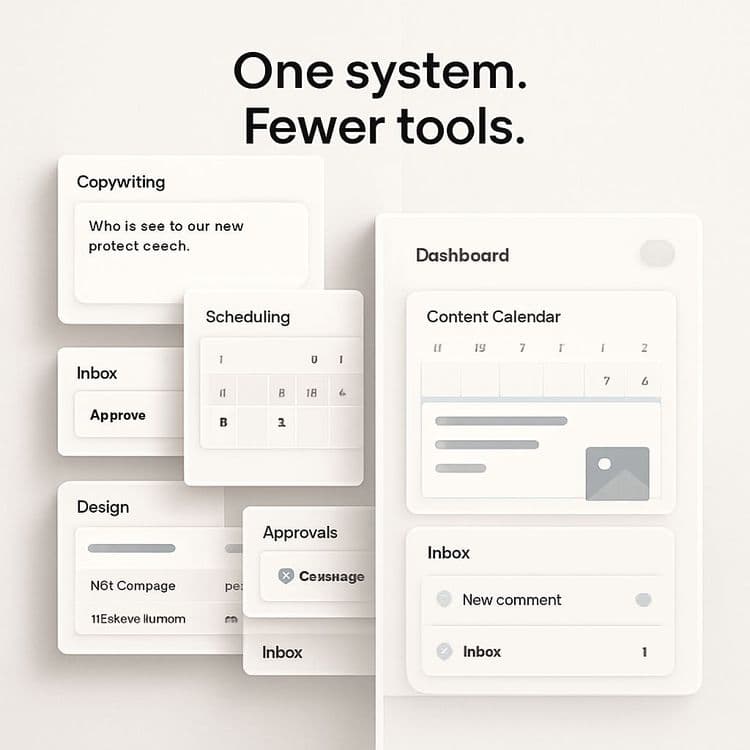
A single system approach doesn’t mean automation replaces your team. It means the routine mechanics of content operations are connected into one workflow so the team can move with less friction. ABEV.ai ABEV.ai is built as a workflow and system engine that centralizes the steps most teams currently scatter across tabs: content planning, caption creation, scheduling, approvals, and basic inbox triage. The system generates drafts that match your brand, suggests posting cadence, routes messages to the right person, and keeps approvals and version history in one place. That changes the feel of the workday. Instead of re-explaining context in every tool, the context lives with the content. Instead of “Where is the latest version?”, everyone sees it. Instead of a calendar in one app and approvals in another, the workflow is continuous. This reduces meetings that exist purely to clarify status and intent. It also reduces errors that happen when people manually move content between systems. The real advantage isn’t that everything becomes automated, it’s that everything becomes connected. And when systems are connected, teams ship faster without degrading quality.
** Tool sprawl doesn’t just slow teams down. It quietly forces teams to operate at a lower creative standard because clarity and context become too expensive. **
It’s important to be explicit: a workflow engine is not an agency, and it is not a replacement for human judgment or creativity. Strategy still comes from people. Brand tone still needs human sensitivity. Final approvals still belong to leaders. The value of the system is that it removes repetitive work that humans shouldn’t spend their best hours doing. Draft generation is a great example: starting from a strong first draft is faster than starting from zero, but humans still decide what matters. Scheduling is another example: publishing across channels is mechanical, but choosing the campaign message is not. Inbox triage is similar: routine inquiries can be categorized and drafted, but nuanced conversations should be escalated. A well-designed system helps teams spend their energy on decisions that create value, not on formatting, copying, and chasing approvals. When you separate “mechanics” from “judgment,” automation becomes safe and predictable. When you try to automate judgment, you create risk. The healthiest teams use systems to eliminate busywork and then raise the standard of human work. They don’t use systems to avoid thinking. That’s the difference between automation that improves quality and automation that erodes it.
The first change most teams notice is consistency. Posting stops being a last-minute scramble because the calendar, drafts, and approvals are connected. The second change is response speed. Routine messages get handled faster, and high-value inquiries reach the right person without getting lost. The third change is reuse. High-performing captions and structures become easy to repurpose, so you improve output without constantly reinventing. The fourth change is clarity. Version history and approval trails reduce internal debates because everyone can see what changed and when. This is especially important when you have compliance needs or multiple stakeholders. Over time, teams regain hours every week that used to disappear in admin and handoffs. Those hours don’t just become “free time,” they become capacity. Capacity to test new ideas, to refine creatives, to experiment with formats, or to respond quickly to market moments. The result is a marketing function that feels calm, not chaotic. And calm teams tend to create better work because they have space to think.
If your current process feels like a relay race where context gets dropped at every exchange, it’s worth considering the alternative: a single system that preserves context and hands control back to the team. The easiest diagnostic question is also the most revealing. How many different tools do you open just to keep your social media running? If the answer is “too many,” the problem isn’t your people. It’s the workflow. And workflow is fixable. When you replace tool sprawl with a system, you don’t lose flexibility, you regain focus. You still choose the strategy, you still own the brand, and you still approve what goes live. You simply stop paying the hidden tax of scattered work. In a world where attention is the scarcest resource, that is one of the highest ROI improvements a team can make.