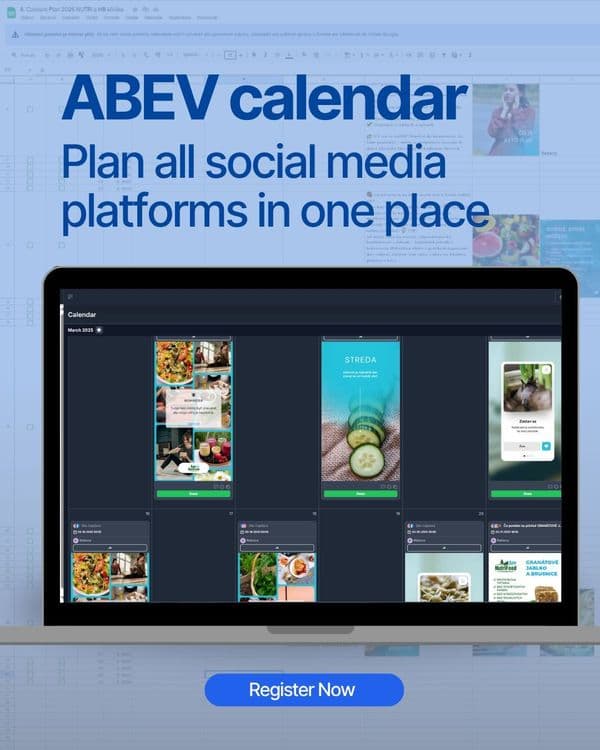
Excel (or Sheets) is great—until you try to run a real content operation inside it. The moment you’re planning across channels, coordinating approvals, and tracking what’s going live when, spreadsheets start to feel like a workaround instead of a system. You’re constantly scrolling, copying, color-coding, and asking “which version is the latest?” A visual calendar changes everything: you see the full month at a glance, drag posts with your mouse, leave comments right where the work happens, and plan as a team without losing context. That’s exactly what ABEV is built for—so content planning becomes fast, clear, and collaborative. And yes, you can register for free.
Spreadsheets are optimized for data, not workflow. They don’t show you the story of your content—they show you rows. That’s fine when one person posts occasionally, but it gets messy as soon as you’re running multiple formats, platforms, and stakeholders. Suddenly the “simple” sheet needs tabs for Instagram, LinkedIn, TikTok, and Facebook. You add columns for captions, links, assets, deadlines, approvals, hashtags, UTMs, owners, and notes. Then comes the real problem: coordination.
Excel can’t naturally handle the realities of a content team:
You can’t visually balance a week (too many promos, not enough value posts).
You can’t drag and reshuffle content when plans change (and they always do).
You can’t keep feedback attached to the post (comments become Slack threads).
You can’t easily answer “what’s scheduled for next Tuesday?” without filtering and double-checking.
And if you’ve ever worked with brands known for operational excellence—think IKEA with structured planning or McDonald’s with consistent campaign coordination—you know the advantage isn’t just creativity. It’s system and execution.
A calendar view is not a “nice UI.” It’s a different way of thinking. Instead of managing content like a spreadsheet, you manage it like a schedule—because that’s what it is. You get an immediate understanding of pacing, timing, and gaps.
With a proper calendar, you can:
See everything at once: monthly view, weekly flow, campaign windows.
Drag and drop posts: shift content when priorities change—without rewriting rows.
Plan together: assign tasks, align responsibilities, and reduce “who owns this?” confusion.
Keep context in one place: captions, visuals, feedback, and status are tied to the post.
It’s the difference between “tracking content” and actually running content.
The hidden cost of spreadsheets isn’t the sheet—it’s the communication around it. When feedback lives in email, Slack, WhatsApp, and meetings, your process becomes fragile. People miss updates, approvals get delayed, and posts go out with outdated captions because someone exported the wrong version.
A calendar-based workflow fixes that by putting feedback where it belongs: on the content itself. Instead of “Can you change the second paragraph?” you get direct comments that everyone can see. That creates a clean loop: draft → review → revise → approve → schedule. No guessing, no hunting, no duplicated work.
If your team is remote or distributed, this matters even more. You don’t just need a plan—you need a shared source of truth that stays current.
A visual calendar reduces content friction. You spend less time managing spreadsheets and more time making better posts. And because everyone sees the same plan in the same place, you cut down on miscommunication, missed deadlines, and “wrong version” mistakes. That’s how you scale output without scaling chaos.
ABEV is designed for the way content actually works today: fast-moving, multi-channel, and collaborative. A calendar view gives you the foundation—visibility and control—while the workflow features help you execute as a team. When you can plan, adjust, and comment without leaving the system, content becomes predictable (in a good way).
This is especially useful if you:
manage multiple clients or brands,
post on multiple platforms,
coordinate approvals with stakeholders,
need to keep posting consistent even when priorities change mid-week.
In short: if content is part of your growth, you need a calendar—not a spreadsheet pretending to be one.
You don’t need to throw everything away overnight. Start by moving one month (or one campaign) into a calendar workflow. Keep your existing structure—topics, owners, publishing cadence—but let the calendar handle the scheduling and collaboration.
Then you’ll notice what changes immediately:
planning becomes visual,
rescheduling becomes effortless,
feedback becomes traceable,
your team stops asking “where is the latest version?”
That’s the moment spreadsheets start to feel like the old way.
If you’re ready to stop managing content in rows and start planning it like a system, register for free and try ABEV’s calendar.