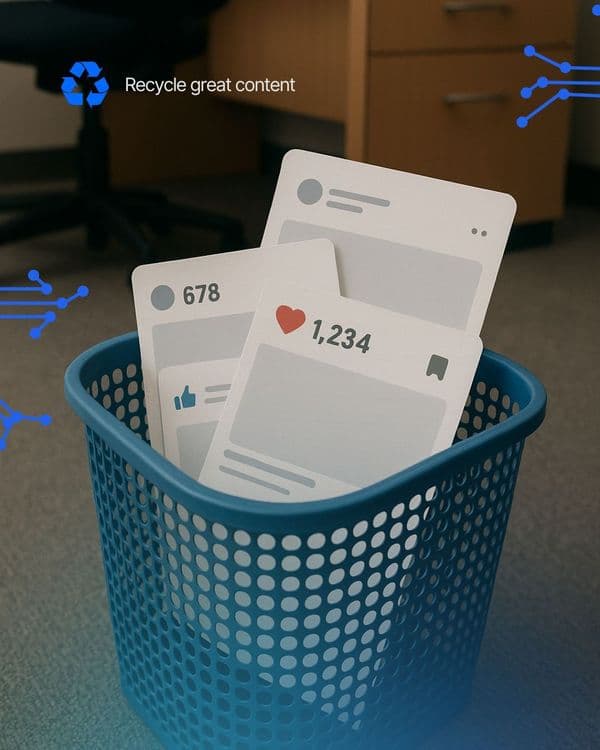
Most teams don’t have a content problem—they have a content waste problem. You publish strong posts, they perform well, and then they disappear into the feed forever. Meanwhile, you’re under pressure to create “something new” every week, even though you already have proven material sitting in your backlog. The smartest move isn’t always producing more. It’s republishing what already worked—at the right time, in the right format, with the right angle. That’s where AI becomes genuinely useful: it can surface older posts with high republish potential, so you spend less time guessing and more time scaling wins.
Social platforms reward consistency, but audiences don’t see everything you post. Even if a piece of content did well, a large part of your followers never saw it—because of timing, the algorithm, or simply because they weren’t following you yet. Republishing isn’t “lazy.” It’s smart distribution.
Big brands do this constantly, just with bigger systems. Think of how McDonald’s reuses core campaign ideas across seasons, or how IKEA repeats evergreen themes about small-space living and organization—because those topics stay relevant. The difference is that smaller teams usually do it manually, if at all, and that’s where the opportunity gets missed.
Republishing works especially well for:
evergreen tips, frameworks, and checklists
posts that triggered strong engagement (comments, saves, shares)
product explainers and “how it works” content
case studies and before/after stories
founder/brand POVs that still match your positioning
If you’ve ever tried to republish manually, you know the friction points:
You don’t remember what performed best six months ago.
Performance isn’t just likes—sometimes a post drove the best leads with average engagement.
Some topics are evergreen, others are time-sensitive.
You want to reuse without looking like you’re recycling the exact same post.
This is why republishing usually ends up being “nice idea, never happens.” It’s not hard conceptually—it’s hard operationally. You need a system that continuously finds candidates, ranks them, and tells you why they’re worth reusing.
The most helpful AI for republishing doesn’t just look for “top posts.” It looks for patterns that predict performance when content is brought back. That can include signals like:
historically strong engagement relative to your baseline
topics that repeatedly perform well for your audience
posts that triggered meaningful comments (not just quick likes)
content that aligns with your current themes and offers
formats that the platform currently favors (for example: concise hooks, clear structure, strong first line)
In other words, AI can do the annoying, time-consuming part: scanning your archive and surfacing a short list of “these are likely to win again.” Then you stay in control of the creative decision.
The best republished posts are not carbon copies. They’re the same core insight, updated for today: a new hook, a sharper example, a fresher CTA, maybe a different format (carousel, short video, thread). When you treat republishing as “version 2.0,” it feels intentional—and it usually performs even better than the original.
This is exactly how you avoid the “are we posting this again?” vibe. You’re not reusing content because you ran out of ideas. You’re reusing content because it’s a proven asset—and you’re improving it.
Here’s a simple system that works for most brands and creators:
AI suggests candidates weekly
A short list of older posts ranked by republish potential.
You pick 2–3 and refresh them
rewrite the first 1–2 lines (new hook)
add one new example, stat, or mini story
adjust the CTA to your current offer or funnel
Change the format when it makes sense
Turn a text post into:
a carousel summary
a “3 takeaways” post
a short video script
a newsletter snippet
Schedule it intentionally
Use your content calendar to avoid repeating the same topic too frequently and to balance republished vs new content.
This gives you reliable output without the constant pressure to invent from scratch.
If you want the fastest wins, start with posts that:
performed above average for you
are evergreen (still relevant today)
align with your current positioning and audience
can be refreshed with minimal effort (new hook + one new angle)
If you’re running B2B, thought leadership frameworks and “mistakes we see” posts usually age well. If you’re running product marketing, feature explainers and use-cases are perfect candidates.
Consistency is one of the strongest predictors of long-term growth, but it’s also what burns teams out. Republishing reduces creative fatigue, keeps your calendar full, and protects quality—because you’re building on proven assets.
Instead of “post every day no matter what,” the goal becomes: publish the best ideas repeatedly, in better forms, at better times. That’s how you build a content engine.