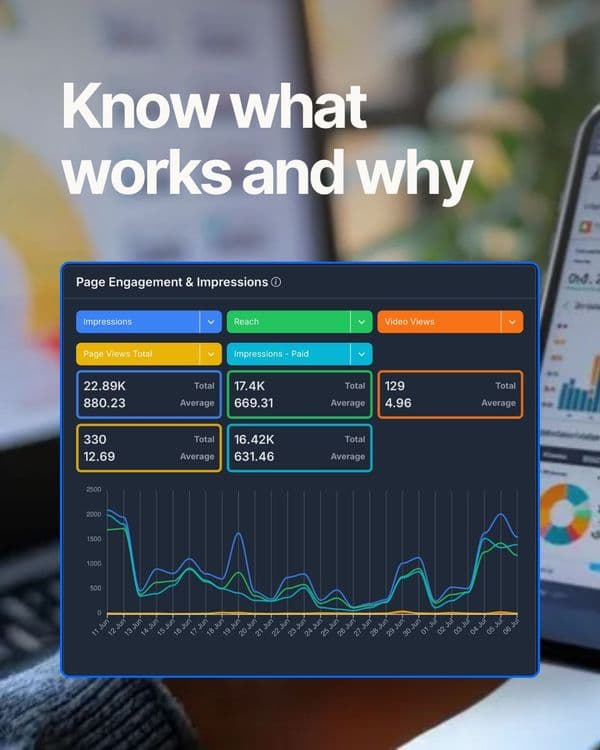
Most social media analytics tell you what happened: likes, reach, impressions, maybe follower growth. Helpful, but rarely enough to make better decisions next week. What teams actually need is the “why” behind performance—what patterns are driving results, which content types consistently win, and where you’re leaving value on the table. When you have deeper performance insights (not just surface-level stats), you stop optimizing for vanity metrics and start optimizing for outcomes: engagement quality, pipeline signals, content efficiency, and repeatable formats. Better data doesn’t just make prettier reports—it makes smarter strategy.
Native analytics are designed for the platform’s priorities, not yours. They’ll show reach, clicks, and engagement—but they often hide the context that matters most for a marketing team: what content is actually moving the needle, and what’s just creating noise.
A few common gaps you’ve probably felt:
You can’t easily compare performance across platforms in a consistent way.
You can’t see which formats win for your brand, not just “in general.”
You can’t tie results back to content themes, funnel stages, or campaigns.
You get numbers, but not actionable direction: “Do more of what, exactly?”
And if you manage multiple brands or clients, it gets worse. You end up exporting, cleaning, and stitching data together—basically rebuilding analytics in spreadsheets. That’s time you should be spending on creative, testing, and strategy.
Better insights aren’t about having more charts. They’re about getting answers to questions your team asks every week, like:
Which topics consistently outperform?
Which hooks (first lines) pull the most attention?
Are we posting too much promo content compared to value content?
What’s the engagement quality—are people commenting thoughtfully or just double-tapping?
Which posts are likely to be republish winners later?
What time windows, cadence, and sequence patterns are working?
This is the difference between reporting and optimization. Reporting tells you what you did. Optimization tells you what to do next.
There’s a myth that analytics kills creativity. In reality, good analytics protects creativity—because it removes guessing. When you know what’s working, your team can spend more energy iterating on strong directions instead of arguing opinions.
This is how the best brands operate. Look at IKEA: their content is creative, but it’s also systemized—repeatable themes, recognizable formats, and consistent pacing. Or McDonald’s: they don’t just “post cool stuff,” they run campaigns with measurable patterns and clear performance feedback loops. The creativity is real, but it’s supported by data discipline.
Likes and reach are the “speedometer.” Useful, but incomplete. What you need is the engine diagnostic: which content pillars drive meaningful engagement, which formats generate actions (clicks, saves, DMs), and which posts quietly underperform despite looking “good.” When you see those patterns clearly, you stop repeating mistakes—and you scale wins on purpose.
If you want analytics that changes your decisions (not just fills a report), focus on these layers:
Content type performance
How do tutorials compare to opinion posts, case studies, product updates, behind-the-scenes, or culture posts?
Topic and pillar performance
Which themes earn attention repeatedly? Which themes look good internally but don’t resonate externally?
Engagement quality
Are comments meaningful? Are people saving and sharing? Do posts spark questions that lead to conversations?
Conversion signals
Clicks are one thing. But if you’re B2B, you also care about profile visits, DMs, “book a demo” behavior, and downstream lead quality.
Consistency and efficiency
Which formats produce the best results per hour of effort? That’s how you scale without burnout.
One of the biggest problems in social reporting is comparing apples to oranges. A “good” LinkedIn post doesn’t look like a “good” Instagram post. If your reporting system normalizes and contextualizes metrics, you can make smarter allocation decisions:
Where to invest creative energy
Which platform deserves more testing
Which formats to repurpose cross-channel
Which content pillars should be the backbone of your calendar
That’s how you move from “posting” to running a real content engine.
The most effective teams build a simple routine:
Review top performers (and why they performed)
Identify one repeatable pattern (topic, hook, format)
Identify one underperforming pattern to reduce or redesign
Choose 2–3 experiments for next week (small, measurable tests)
Feed the insights back into the calendar and the content briefs
When that loop runs consistently, you’ll see quality rise—even if you post the same amount.