The hardest part of retail marketing isn’t launching a campaign—it’s making it feel relevant in 120 different places at once. A national spring push can be beautifully produced at HQ, fully compliant, and strategically sound… and still fall flat locally if it doesn’t speak to the store’s real shoppers. City-center foot traffic behaves differently than a suburban family hub. A tourist hotspot cares about different products than a commuter corridor. The question becomes: how do you scale localized content without turning store teams into part-time content creators? The answer isn’t more meetings or more spreadsheets. It’s building a workflow where HQ keeps control of brand and compliance, while stores get fast, tailored content that still feels warm and local.
Retail chains live in two realities at the same time: the brand is national, but shopping is personal and local. People don’t experience “Lidl” or “Kaufland” as an abstract logo—they experience the store near their home, the staff they recognize, the parking situation, the local assortment, and the community vibe. That’s why local content works: it reflects a shopper’s daily life, not just a marketing calendar. The problem is that creating local content at scale is operationally heavy. Store managers aren’t hired to write captions, brainstorm hooks, and debate imagery. Even regional marketing teams struggle because they’re constantly coordinating approvals, assets, and deadlines across many locations. And when localization is manual, quality becomes uneven—some stores post well, others go quiet, and the brand voice starts drifting. The result is predictable: inconsistent engagement, slower response times, and a lot of stress around “we should post more locally.” What chains need is a system that produces localized drafts quickly while keeping the brand promise unmistakably consistent.
The best model is simple: HQ owns the campaign foundation; stores own the final relevance. Headquarters provides core creative, key messages, compliance constraints, and any claims that must stay standardized. Then stores receive localized variations that reflect their context—local suppliers, store-specific promos, community events, and even weather-sensitive offers when it makes sense. The magic is not “creating hundreds of posts.” The magic is creating hundreds of posts that still feel human. That requires structured inputs: a brand guide, a campaign brief, and local variables (store type, location, top categories, local landmarks, event calendar). When those inputs are organized, generating localized drafts becomes a repeatable production process rather than a creative firefight. You also get better pacing: the calendar stays coherent across the chain, but each store’s feed feels distinct. Over time, this approach creates a competitive advantage—because local relevance becomes systematic, not dependent on the one store manager who happens to like social media. And once it’s a system, you can scale it across regions without losing quality or control.
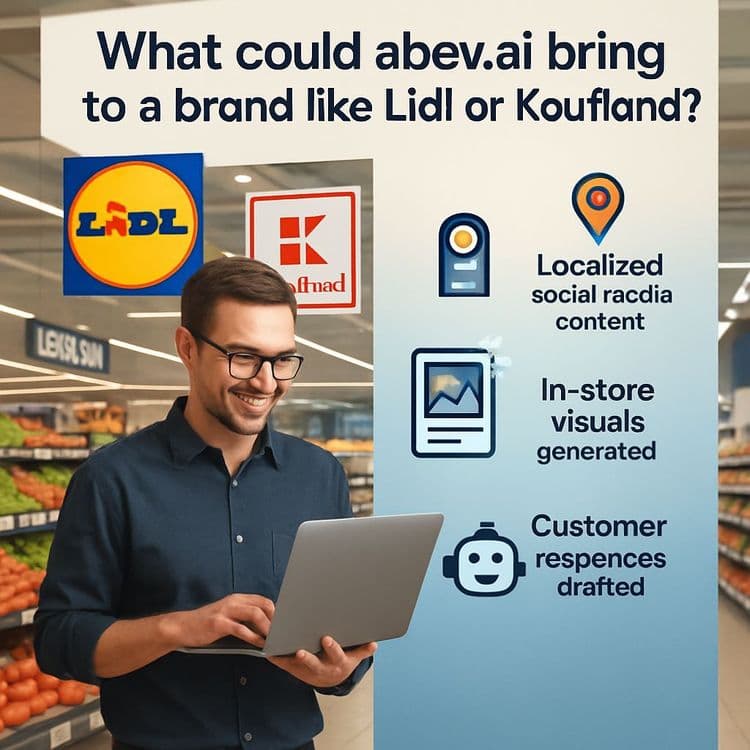
In a pilot workflow like the one you described, the starting point is straightforward: HQ uploads the brand guide and campaign brief into abev.ai. From there, the system can generate localized variations of hero posts tuned to each store’s audience and top-selling categories, instead of forcing every store to post the same generic message. It can also create image prompts and quick edits for in-store visuals, so the content isn’t stuck recycling the same asset pack forever. Most importantly, it can draft consistent replies for local community comments and questions through a unified inbox—so customers aren’t getting half-answers depending on who is online. The operational shift is immediate: store managers receive tailored drafts they can approve in minutes, rather than writing from scratch. Engagement improves because posts reference local cues that feel real—nearby landmarks, familiar neighborhood language, or locally popular products. Response times improve because the unified mailbox routes urgent conversations to the right people instead of getting lost across platforms. And the brand voice stays consistent because the system is anchored to the same guidelines everywhere. The result isn’t just “more content.” It’s content that feels local, performs better, and doesn’t burn out the team that has to run it.
Retail wins on relevance. Chains that master “national efficiency + local heart” can produce hundreds of localized posts fast, stay compliant, and still feel like part of the community. That combination—speed at scale, true personalization, brand safety guardrails, and operational calm—is how small local teams move like large ones without losing trust or tone.
Scaling localized content is powerful, but it has to be safe—especially in retail, where promotions, pricing language, and claims can trigger compliance issues fast. This is where guardrails matter. A good system needs to enforce what must stay consistent: disclaimers, restricted phrases, pricing rules, promo terms, and brand tone. It should also flag anything ambiguous for human review—like sensitive customer complaints, controversial topics, or unclear promotional details. That balance is what makes localization sustainable: automation handles routine volume, while humans handle nuance and risk. Guardrails also protect internal teams from constant “double-check everything” anxiety, because the workflow itself reduces the chance of publishing something off-brand. Over time, this builds trust in the process, which is essential if you want stores to adopt it consistently. When store teams feel supported—rather than monitored—they collaborate better and post more confidently. And when compliance feels baked-in instead of enforced at the end, approvals become faster without becoming sloppy. That’s how you scale without sacrificing reputation.
The same principles apply beyond national players. Franchise groups, regional grocers, and multi-location independents have the exact same challenge: they need content that feels local, but they don’t have the headcount to execute like a large brand. With a structured AI-assisted workflow, a small team can maintain consistent brand voice while still tailoring content to different neighborhoods and store realities. You can run seasonal campaigns, local events, supplier spotlights, and “what’s fresh this week” posts without rebuilding the process every time. You can also compete more effectively against bigger players because you’re not trying to beat them on budget—you’re competing on relevance and community connection. And when the inbox is unified, customer experience improves too, because shoppers get faster, clearer answers even when the team is lean. That’s what “big-league consistency” looks like in practice: not more effort, but better systems. If you’re trying to scale local marketing without scaling chaos, this approach is one of the most practical upgrades available.
If you want to test this without disrupting operations, start with a controlled pilot. Pick a subset of stores—different types and regions—to capture real variety. Load a simple brand guide, define promo and compliance rules, and provide a campaign brief with the core creative. Then add local inputs: store category priorities, local events, and a short list of local references that feel authentic. Run the system weekly: generate localized drafts, approve quickly, schedule through a shared calendar, and manage replies through a unified inbox. Track outcomes that matter: time spent per store, posting consistency, engagement quality, response times, and error rates (or “rework” rates). In most cases, the story becomes clear quickly—either the workflow reduces effort and improves performance, or it needs refinement in inputs and guardrails. Either way, you get real operational learning instead of abstract “AI strategy.” And once the pilot works, rollout becomes a training and adoption problem—not a creative problem. That’s the moment national efficiency with local heart becomes achievable at scale.