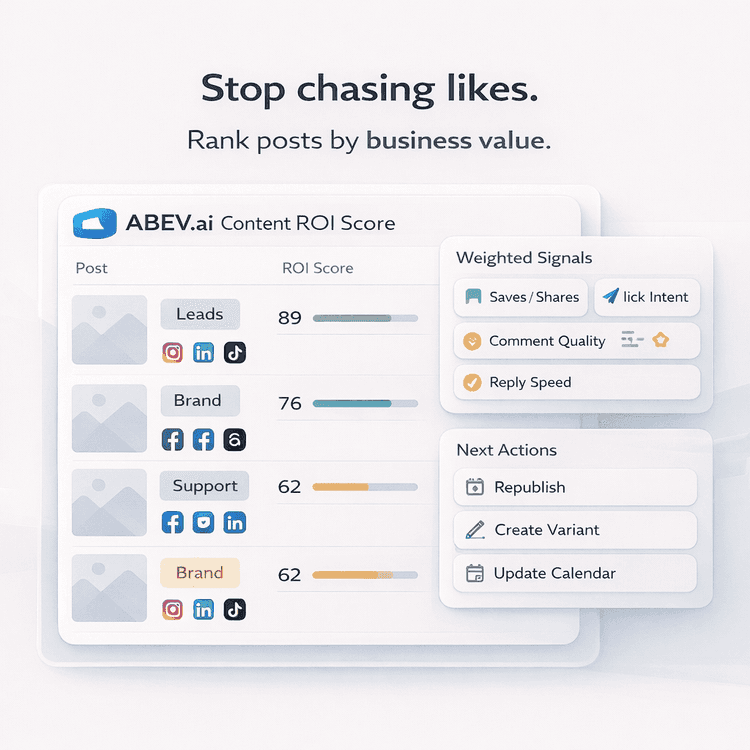
Most marketing teams don’t suffer from a lack of analytics. They suffer from a lack of direction. You can have dashboards on dashboards and still end up asking the same question every morning: “What should we post next?” That’s the dashboard paradox. Raw metrics tell you what happened, but they rarely tell you what to do. The result is predictable: teams optimize for what’s easy to measure (likes, reach), while the business cares about outcomes (leads, hires, pipeline, support load). When those two realities drift apart, content becomes consistent in volume but inconsistent in purpose. “Content ROI Score” is a practical way to close that loop by ranking posts by business value instead of vanity metrics.
A workflow system like ABEV.ai makes this operational because it links planning, drafting, approvals, scheduling, and performance signals in the same loop. The goal isn’t to replace judgment. It’s to stop teams from guessing when the data is already implying a next move.
Likes and reach are convenient because they’re visible and universal. They feel like progress. But they often fail as decision signals because they don’t reflect intent or business impact. A post can get strong reach because it’s entertaining, but generate zero pipeline. A post can get modest likes but trigger the right conversations in comments and DMs, and those conversations can convert. Across platforms, the problem gets worse because each network measures interactions differently, and definitions can shift over time. When teams optimize primarily for vanity metrics, they end up selecting content that performs well inside a platform’s native logic but doesn’t necessarily move the business. That creates a slow disconnect: marketing feels busy, leadership feels unconvinced, and the team keeps publishing without a clear theory of value.
Content ROI Score isn’t a magical attribution model. It’s a structured scoring approach that attaches a goal to each post and then evaluates performance using weighted signals that better represent business value. The key is that the score is intentional: it’s based on your definitions and priorities, not on whatever a platform decides to highlight this month. The system starts with the question most teams skip: what is this post meant to achieve? When intent is declared upfront, performance becomes interpretable. You can judge a post against its purpose, not against a generic engagement benchmark.
The simplest change that unlocks clarity is a goal tag per post. Content ROI Score works best when every post is assigned one primary goal such as:
Leads
Brand
Hiring
Support deflection
This single step changes everything downstream. A lead post can be evaluated with intent signals and conversion proxies. A brand post can be evaluated with saves, shares, and high-quality comments. A hiring post can be evaluated by clicks to job pages and applicant-quality engagement. A support deflection post can be evaluated by whether it reduces repetitive questions and improves response performance.
Once goals are defined, the score uses weighted signals, meaning some actions matter more than others:
Shares and saves can matter more than likes, because they indicate usefulness and redistribution.
Comment quality matters more than raw comment count, because one thoughtful comment from the right person can beat fifty emojis.
Reply speed and resolution can count for support deflection posts, because speed directly affects customer experience and workload.
Negative sentiment can lower the score and trigger review, because content that “performs” but damages trust is not a win.
The goal isn’t more metrics. The goal is turning signals into repeatable decisions about what to publish next.
If you manage content across Facebook, Instagram, LinkedIn, TikTok, and Threads, you already know the pain: metrics aren’t directly comparable. Normalization doesn’t mean pretending platforms are identical. It means applying one consistent definition of business value and scoring signals accordingly, so you’re not over-investing in a channel just because its native dashboard “looks better.”
A useful score shouldn’t end in a slide deck. It should drive action:
Republish suggestions: surface posts with high ROI that deserve another run.
Variant suggestions: generate a new hook, CTA, or format based on what worked.
Calendar adjustments: shift next week’s plan toward proven patterns, not preferences.
This is where systems thinking beats dashboard culture: performance updates automatically shape the next calendar.
Imagine a B2B post that gets modest likes but triggers high-quality comments from decision makers and leads to a few inbound DMs. In a vanity-metrics world, it might be labeled “average.” In a business-value scoring world, it can rank as a top performer because the signals reflect intent and relevance. That shift changes everything: teams stop rewarding content for being loud and start rewarding it for driving outcomes.