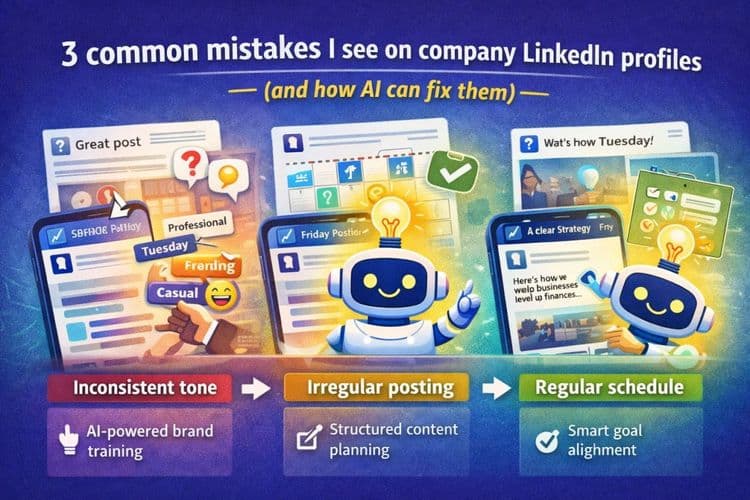
After auditing dozens of company LinkedIn profiles, the pattern becomes hard to ignore: most profiles aren’t failing because the brand is “bad at marketing.” They’re failing because small, repeated mistakes chip away at trust and waste time week after week. LinkedIn is often the first place a prospect checks after seeing an ad, a website, or a referral. If the profile feels inconsistent, outdated, or unclear, the buyer’s confidence drops before you ever get a chance to pitch. The good news is that these mistakes are fixable, and they’re mostly workflow problems. With the right system, you can keep your profile and content consistent without turning it into another manual chore.
The first trust leak is tone and positioning drift. One week the company sounds formal and corporate. The next week it sounds casual and meme-like. The next week it’s generic “marketing speak” with no clear point of view. This usually happens because multiple people touch content, or because the team is rushing and writing from scratch each time.
Why it matters: LinkedIn trust is built through repetition. Buyers need to hear the same promise in different angles over time. If your voice changes constantly, the brand feels unstable and less credible. Think of brands like IKEA or Bosch. Their voice is recognizable because it’s consistent, not because every post is genius.
How to fix it: define a simple brand voice guide that includes:
tone (confident, friendly, direct, premium, etc.)
phrases you use often and phrases you avoid
CTA style (soft invite vs direct action)
examples of “on-brand” posts
Then systemize it. When a platform like abev.ai is trained on your brand guide and best-performing posts, it can generate drafts that start aligned, so humans are editing for nuance, not rebuilding tone from zero.
The second mistake is “random posting.” It looks like activity, but it doesn’t compound. You’ll see a product post, then a hiring post, then a generic quote, then a company update, then silence for two weeks. This creates noise, not momentum.
Why it matters: LinkedIn rewards patterns. When your content follows repeatable themes, the platform learns who engages with you, and your audience learns what to expect. Without a system, you can’t iterate. You can’t even tell what worked, because nothing is consistent long enough to compare.
How to fix it: build a simple content operating system:
3 to 5 content pillars (education, proof, product, POV, community)
2 to 3 repeatable formats per pillar (how-to, myth vs reality, case study, checklist)
a calendar cadence your team can sustain
A tool like abev.ai helps by proposing a prioritized editorial calendar based on goals and past performance, so planning stops being a weekly scramble.
The third mistake is when the profile itself doesn’t support conversion. The content might be decent, but the profile basics are outdated or vague:
the headline is generic
the “About” section doesn’t say who you help and how
the banner doesn’t reinforce positioning
the featured section is empty or irrelevant
the CTA is missing or unclear
Why it matters: your LinkedIn profile is your trust landing page. People who like a post often click the profile next. If the profile doesn’t instantly confirm credibility and clarity, you lose the conversion window.
How to fix it: treat the profile like a funnel asset:
headline: clear category + outcome
about: who it’s for, what problem you solve, proof, and a clear next step
featured: 3 to 5 high-trust assets (case study, demo, lead magnet, product page)
banner: one strong promise with simple design
Then maintain it consistently. A system can help keep messaging aligned across posts and profile elements, so you’re not constantly “repositioning” by accident.
A profile audit usually reveals the same truth: the brands that win on LinkedIn are not the ones posting the most. They’re the ones with a consistent voice, a repeatable content system, and profile fundamentals that match the message. Fix those three areas and your LinkedIn presence starts compounding instead of resetting every week.
The role of a system like abev.ai is not to “do LinkedIn for you.” It’s to remove manual churn and enforce consistency:
generate drafts aligned with brand tone
adapt content formats without rewriting everything
plan and schedule in one calendar
track performance clearly and reuse winners
keep collaboration and approvals inside one workflow
That makes LinkedIn easier to run as a predictable process, even with a small team.