Booking.com operates across countless markets, and that scale is exactly where social media operations tend to break down. What starts as one campaign quickly turns into a maze of documents, language variants, approval threads, and last-minute local edits. Teams end up spending more time managing versions than building momentum. And when speed matters, rushed workflows invite inconsistencies that dilute brand perception across regions. The good news is that multilingual social doesn’t have to mean multilingual mess. With the right workflow, you can keep one campaign narrative while still sounding native in every market. This article explains how a two-click approach to translation and platform adaptation can compress production time while improving consistency. It’s about removing friction, not removing local nuance.
Multi-market social usually fails for one simple reason: the “source of truth” is unclear. One person edits the master copy, another person translates it, and a third person tweaks it for a platform, which creates branches that drift apart. After that, regional teams add local context, and suddenly you’re comparing multiple versions of “the same post” that no longer match. Even strong teams get stuck in repetitive mechanics: copying text from one doc to another, hunting for the latest approved line, or reformatting the same message for different channels. The operational burden is invisible until you scale to multiple countries, and then it becomes the bottleneck. That bottleneck shows up as delays, inconsistent tone, and “good enough” localization. It also shows up as extra review cycles, because stakeholders can’t quickly see what changed and why. The result is predictable: campaigns ship late, or they ship unevenly across markets. To scale cleanly, you need a workflow that keeps the campaign core unified while letting localization happen in a controlled, trackable way.
Translation alone isn’t the hard part anymore, but usable translation still is. A direct translation often misses the intent of the post, the natural rhythm of the language, and the style expectations of the platform. That’s why the most time-consuming phase is usually the polish: shorten it, make it sound less literal, change the CTA, adjust the tone, and fix what doesn’t feel local. Now multiply that by every market and every channel, and you get the version chaos everyone recognizes. The better approach is to generate drafts that are already shaped for how each channel behaves, so you start from almost done, not barely started. That means adapting length, tone, structure, and CTA, not just swapping words from one language to another. It also means keeping a consistent brand voice so local teams aren’t reinventing the brand on every post. When the first draft is closer to publish-ready, approvals get faster and regional edits become surgical instead of messy rewrites. Ultimately, speed improves because quality improves early, not because you cut corners.
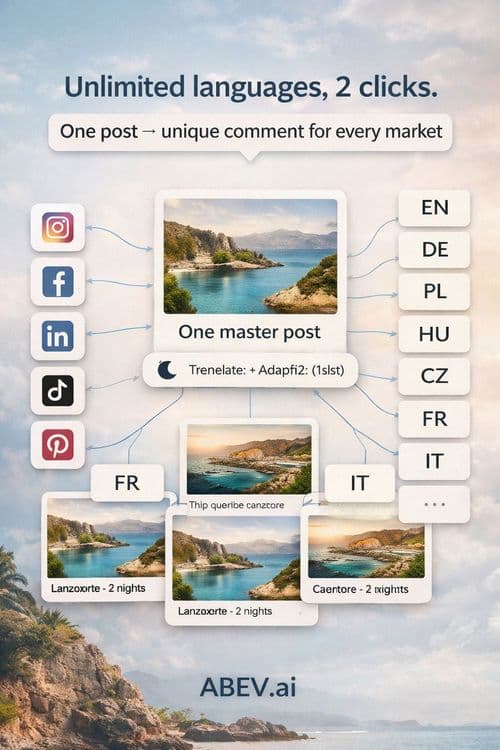
ABEV.ai ABEV.ai removes the friction by making multilingual, multi-channel drafting a single workflow instead of a chain of separate tasks. You start with one master post idea, then pick any number of target languages, whether that’s six, twelve, or effectively unlimited. Next, you choose where the content should run across platforms like Instagram, Facebook, LinkedIn, TikTok , and Pinterest. In two clicks, you generate translated drafts that are also platform-optimized, so each version matches the expectations of that network. Instead of copy-pasting between documents, you’re working inside one consistent system. Instead of asking “Which version is final?”, the workflow keeps a clear trail of what’s generated, what’s edited, and what’s approved. This matters because multilingual campaigns often fail at the handoffs, not at the writing. When drafts are created centrally, regional teams can focus on what they should do best: local relevance, compliance, and nuance. And when the workflow is repeatable, you can scale campaigns without hiring a small army of coordinators.
** The real win is that multi-country teams stop debating versions and start improving outcomes: fewer rewrites, fewer approval loops, clearer ownership, and faster time-to-post, while still leaving room for local nuance where it actually matters. **
In practice, the workflow feels less like translation work and more like cloning a campaign into multiple markets with guardrails. You choose your channels once, then replicate across markets with AI-adapted copy that already follows best practices for each format. You get localized drafts that are native to the platform, so nobody has to manually reformat the same content five different ways. You maintain a single source of truth for brand tone and approvals, which prevents drift when multiple people touch the message. You route country-specific edits through the same system and keep a central view of versions, instead of tracking changes across chats and files. That reduces review cycles because stakeholders can assess output quickly and consistently. It also reduces stress, because “last-minute changes” stop being a fire drill across ten markets. Over time, teams build speed simply by repeating the same clean process rather than reinventing it for every campaign. If you manage social for a multi-market brand or an agency handling multi-country accounts, this is the difference between scaling content and scaling chaos.
Register on abev.ai and try the free trial (all features for 1 company).