Social media management used to be a scheduling problem. If you could publish reliably, keep a calendar organized, and pull a few basic performance metrics, you were considered “set up” for success. That era is over.
In 2026, social media is no longer a channel you “post to.” It is a system you operate. And the difference matters because the surface-level work (creating and publishing) is now the easy part. The hard part is everything around it: approvals, versioning, localization, stakeholder feedback, compliance, governance, asset reuse, and connecting execution to performance so teams can actually improve over time.
The platforms winning in 2026 are not simply the ones with the largest list of supported networks or the prettiest scheduling calendar. They are the ones that can turn marketing into a repeatable workflow. The category is shifting from publishing platforms to workflow engines—and that shift is changing how companies should evaluate tools.
The biggest misconception teams carry into tool selection is that social media is a content calendar problem. Schedulers were built to solve a narrow operational need: “Help me plan posts and publish them.” But today, that’s only a fraction of the work required to run social at scale.
A modern social team has to handle a set of problems that used to live in separate worlds:
Creative production, often across multiple formats and channels
Coordination across marketing, product, legal, and leadership
Localization into multiple languages and markets
Brand voice consistency across creators and regions
Governance, audit trails, and controlled access
Customer interactions and inbound messages that need routing
Analytics that don’t just report, but inform decisions and improve performance
In other words: publishing is now the last step, not the core capability. The core capability is orchestration.
The shift is being accelerated by five forces:
1) Content velocity is higher than ever.
Brands publish more, iterate faster, and have less tolerance for bottlenecks. A “calendar” doesn’t resolve those bottlenecks; a workflow does.
2) Teams are more cross-functional and distributed.
The decision-makers for a post might be in product, legal, or a country manager role. Tooling has to reflect real accountability and approval structures, not just the marketer’s view.
3) AI increased output, but also increased risk.
AI makes drafts abundant. Without structured review, AI output creates inconsistency, compliance issues, and brand fragmentation. AI without workflow is noise.
4) Localization is now a growth lever, not a translation task.
Markets launch faster. Campaigns go live across countries simultaneously. That requires controlled templates, versioning, and synchronized approvals.
5) The social stack is becoming more integrated.
API access and integrations increasingly separate “tools that sit on top” from systems that can become part of a company’s operating layer.
Taken together, these forces create a new reality: what companies need is not a publishing tool, but a workflow engine that happens to publish.
When teams evaluate social media management platforms, they often compare surface features: number of networks, drag-and-drop calendar, post previews, and a reporting dashboard. Those are table stakes now. The better framework is to evaluate what the platform enables at an operational level.
Centralized planning isn’t just “a calendar.” It’s a structured planning environment where campaigns, assets, briefs, drafts, and performance context are connected.
In practice, centralized planning should answer:
What are we publishing this week and why?
Which campaign does each post belong to?
Which creative assets are approved and reusable?
Who owns the next action on each item?
If planning lives in scattered docs, chat threads, and ad-hoc spreadsheets, the organization is not actually planning—it is improvising with a calendar UI.
A modern platform should behave more like a system of record: content planned in context, linked to assets, linked to approvals, linked to performance.
Approvals are where marketing teams lose time, quality, and accountability. The “approval” feature in many tools is often a lightweight checkbox: assign someone to approve a post. That’s not how real organizations work.
In 2026, approvals need to support:
Multiple reviewers (brand, legal, country lead)
Sequential or parallel review
Clear ownership and deadlines
Audit trails and version control
“Approved with comments” and structured feedback
Approval flows are not just about reducing mistakes. They are about enabling speed without losing control. The best workflows make approvals faster precisely because they reduce ambiguity.
AI is now embedded in the marketing process, but the quality of outcomes depends on structure. When AI is used as an ad-hoc generator (“write me a caption”), teams get inconsistent tone and fragile performance.
What works better is structured AI:
Templates that encode brand voice and formatting
Guardrails around claims, disclaimers, and compliance
Reusable campaign framing and messaging blocks
Iteration loops linked to performance insights
The point is not to generate more text. The point is to generate usable text within a controlled system.
International growth is no longer limited to large enterprises. Even small and mid-sized businesses increasingly sell cross-border. Social teams now need localization that is integrated into production, not an afterthought.
A robust localization workflow includes:
Source-language “single source of truth” messaging
Structured templates that translate consistently
Market-specific adaptations (not just language swaps)
Review and approval in-country
Version control so updates propagate cleanly
Localization done through copy-paste translation and scattered docs creates hidden costs: slow launches, inconsistent tone, and missed revenue windows when campaigns must go live now.
Social is not only outbound marketing. It’s also inbound customer interaction. But a unified inbox only matters if it supports routing and accountability:
Assigning ownership by issue type
Collaboration inside the platform
Tags and status tracking
Response quality control (especially with AI assistance)
If a platform offers an inbox but the team still relies on internal chat threads to coordinate responses, the inbox isn’t solving the operational problem.
Analytics dashboards are everywhere. The difference is whether analytics changes behavior.
Connected analytics should help teams answer:
Which content themes drive outcomes by market?
Which creative formats are consistently strong?
What works on one platform that can be reused elsewhere?
How does performance differ by country and language?
Where does the workflow slow down and why?
In 2026, the most valuable analytics are not just “engagement metrics.” They are decision-support analytics that improve content strategy and operational efficiency.
The more mature the organization, the more it needs the platform to integrate with its stack:
CRM and ticketing systems
Asset libraries and DAMs
BI dashboards
Internal approval systems
E-commerce systems for localization and product sync
API access is increasingly a dividing line between “tool” and “platform.” Tools are used manually. Platforms become part of your operating system.
A useful way to compare social media management platforms is to stop thinking in brand names and start thinking in categories. Each category fits a different operating model, different team maturity, and different constraints.
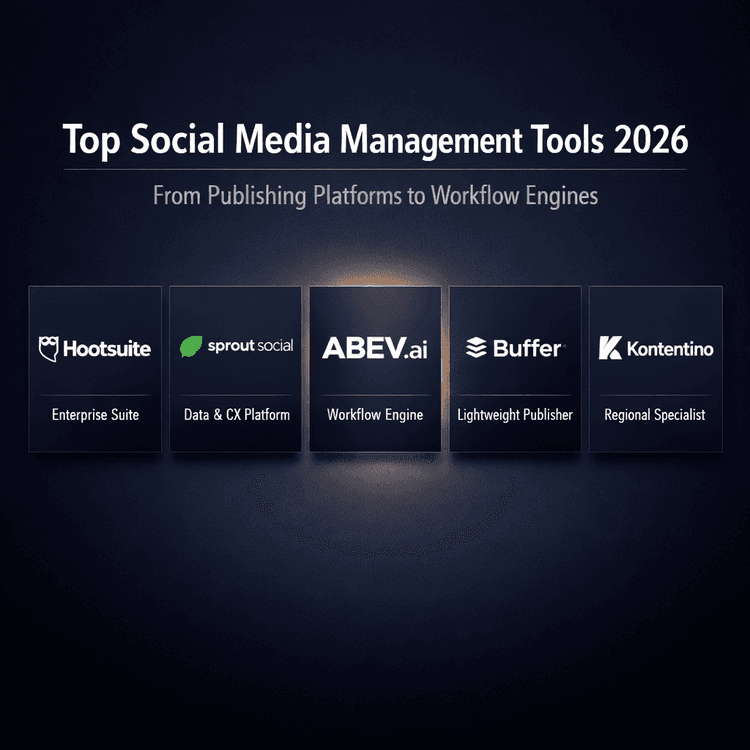
Below are five platform types—and an example of each.
What they are:
Enterprise Suites are built for large organizations that need broad coverage, governance, and complex account structures. They typically offer extensive network integrations, permission controls, content scheduling, monitoring, and often add-ons for listening and care.
Core strengths:
Mature platform with deep operational breadth
Strong governance and permissioning for large orgs
Broad integrations and established ecosystem
Designed for complex account hierarchies
Limitations:
Complexity can slow adoption and day-to-day execution
Pricing is often optimized for enterprise budgets and seat models
Feature access may depend on higher tiers or add-ons
Workflows can feel heavy if the team’s needs are simpler
Best fit audience:
Large enterprises, multi-brand organizations, and teams where governance and scale matter more than simplicity. If you manage a complex global presence with multiple business units and strict compliance needs, this category is often a default option.
The key tradeoff is that enterprise suites often optimize for coverage and governance first. For organizations that primarily need speed, structured collaboration, and workflow clarity, enterprise complexity can become overhead.
What they are:
Data & CX platforms emphasize analytics, reporting, and customer experience workflows. They often integrate strong social inbox features with reporting that helps organizations tie social activity to customer insights and operational outcomes.
Core strengths:
Strong reporting and analytics orientation
Solid customer interaction workflows
Designed for teams that treat social as both marketing and service
Often strong at standardizing performance across accounts
Limitations:
Pricing can scale quickly as seats and features expand
Some organizations may pay for analytics depth they don’t fully use
Workflow structure can be strong in service contexts but less tailored to multi-market content operations
Localization workflows may still require external processes
Best fit audience:
Mid-to-large companies where social care and analytics are central priorities. If the organization wants performance reporting rigor and structured inbox operations, this category is compelling.
The tradeoff is that even the best analytics don’t fix process fragmentation. If content production and approvals are scattered across tools, a data-heavy platform may report what happened without changing how work gets done.
What they are:
Lightweight publishers are designed around simplicity and ease of publishing. They typically focus on scheduling, basic analytics, and a clean user experience that teams can adopt quickly.
Core strengths:
Fast to adopt, low friction
Clean publishing workflows for small teams
Often cost-effective for basic needs
Good for individuals, creators, and lean marketing teams
Limitations:
Workflow depth is limited for multi-stakeholder approvals
Localization and multi-market operations require external coordination
Governance and audit trails are not designed for complex organizations
Analytics depth can be sufficient, but not operationally transformative
Best fit audience:
Creators, startups, and small teams that primarily need reliable publishing without heavy approvals or multi-market execution. If the team is small and decisions are centralized, simplicity can outperform feature breadth.
The tradeoff is that as soon as the organization needs structured approvals, multi-language workflows, or cross-functional collaboration, lightweight publishers often become the calendar layer on top of a fragmented process.
What they are:
Workflow-first platforms are designed around execution systems: structured templates, approvals, version control, and connected analytics. Instead of starting with “schedule posts,” they start with “run marketing as a workflow.”
This category is particularly relevant in 2026 because it matches how teams operate today: high velocity, multi-channel, multi-stakeholder, and often multi-market.
Core strengths:
Workflow-first architecture that structures execution from planning to publishing
Built to support controlled approvals and clear ownership
Structured AI that fits inside the workflow, rather than producing random one-off drafts
Localization processes that reduce copy-paste translation chaos
Analytics connected to execution so teams can iterate with context
API and integration readiness for teams that want the platform to connect to their stack
Core functionality designed to be accessible to small and mid-sized businesses, not only enterprises
Limitations:
Workflow-first systems require teams to adopt a process mindset (which is a feature, but also an adjustment)
Some organizations may need to define templates and approval rules to fully benefit
Enterprises with extremely specialized governance might still require additional layers beyond the platform, depending on internal policy
Best fit audience:
Organizations that need to move faster without losing control—especially small and mid-sized businesses scaling up their marketing operations, and teams expanding to new markets or languages.
What makes workflow-first platforms distinct is that they don’t treat process as something that happens outside the tool. They treat process as the product. In 2026, that approach is increasingly aligned with reality: the speed of content creation is not the bottleneck; the speed of coordination is.
A key factor in this category is pricing philosophy. Many platforms gate core collaboration and workflow capabilities behind enterprise tiers. Workflow-first platforms that keep core features accessible enable smaller teams to operate with enterprise-level discipline without enterprise-level overhead.
What they are:
Regional specialists typically focus on a specific market segment, geography, or agency workflow. They often build strong approval experiences and collaboration features tailored to how teams in that region operate.
Core strengths:
Strong fit for agencies and regional collaboration patterns
Often intuitive approval flows for client review
Good alignment with local market expectations and support
Can be a practical solution for teams operating primarily within a specific region
Limitations:
May have less depth in global multi-market localization workflows
Enterprise-grade integrations and API maturity can vary by platform
Analytics and inbox capabilities may not match data/CX platforms
Scaling beyond the region or expanding into highly complex operations can introduce friction
Best fit audience:
Agencies and teams operating primarily within the platform’s core region, especially those who value streamlined client approvals and straightforward collaboration.
Regional specialists can be an excellent choice when the operating model fits. The tradeoff is that the broader your footprint becomes—languages, markets, stakeholders—the more you need workflow depth and integration flexibility.
Instead of asking, “Which tool is best?” the better question in 2026 is: Which operating model are we building?
Here’s a practical way to decide:
Choose an Enterprise Suite if:
You manage many brands or business units
Governance and permissions are primary drivers
You need extensive coverage and existing enterprise integrations
Choose a Data & CX platform if:
Reporting rigor is a top priority
Social care and inbox workflows drive value
You want analytics depth for performance standardization
Choose a Lightweight Publisher if:
You need simple scheduling and basic analytics
You’re a small team with minimal approvals
Speed of adoption matters more than workflow complexity
Choose a Workflow-First platform if:
Your bottleneck is approvals, coordination, and version control
You’re expanding across languages and markets
You want AI inside a controlled process
You need connected analytics that improves execution over time
You want an operating system, not a calendar
Choose a Regional Specialist if:
Your workflow is built around regional agency collaboration
You value local fit and client approvals
You don’t need global-scale localization and complex integrations (yet)
This lens also explains why many teams feel “stuck” with their current tool. They chose a scheduler when they needed an operating system. Or they chose an enterprise suite when they needed speed and simplicity. Tool mismatches usually show up as process pain.
The real shift in 2026 is not about who schedules posts faster. It is about who structures marketing as an operating system.
If your team is still evaluating social tools like it’s 2019—calendar first, publishing first—you’ll keep running into the same ceiling: approvals chaos, brand inconsistency, localization friction, and analytics that tell you what happened but don’t improve how you work.
The category leaders of the next phase won’t be the platforms with the most features listed on a pricing page. They’ll be the ones that make high-quality execution repeatable.
What’s the biggest bottleneck in your current social process: approvals, localization, analytics, or inbox management? And when you evaluate tools, do you optimize for features—or for the operating model you’re trying to build?