For the past two years, marketing teams have been experimenting with AI assistants.
They generate captions. They rewrite headlines. They summarize reports. They help brainstorm campaigns.
Useful? Absolutely.
Transformational? Not yet.
Because assistants generate output. Agents execute intent.
The shift from AI tools to AI agents is not about better prompts. It is about changing how marketing operations function at a structural level.
And that shift is already underway.
An AI tool responds.
An AI agent acts.
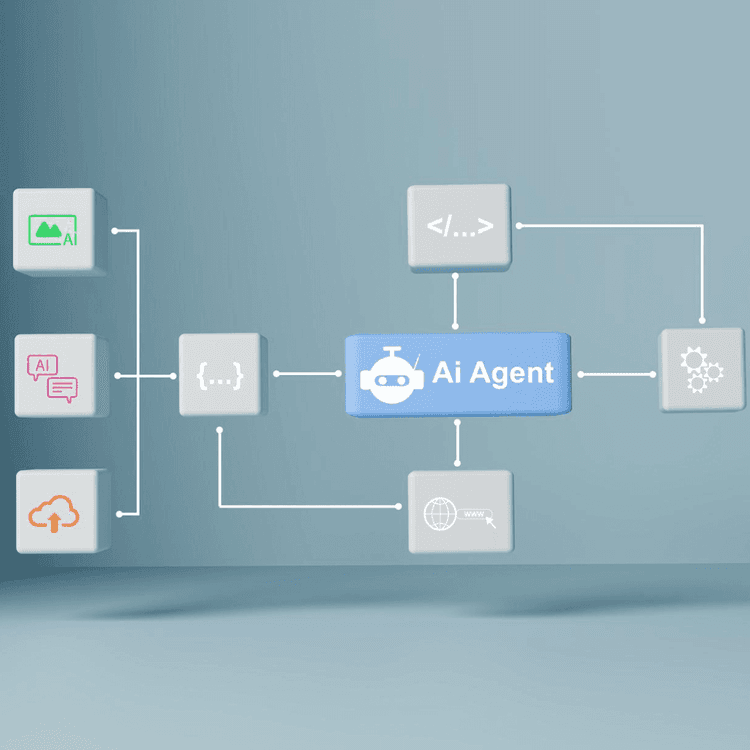
An assistant waits for instructions, produces content, and stops. An agent understands objectives, performs tasks within a defined system, makes decisions inside boundaries, and continues operating.
In marketing terms:
AI tools help create.
AI agents help operate.
That distinction is subtle but powerful.
When content production still requires manual routing, manual scheduling, and manual performance evaluation, AI remains a productivity layer. When AI begins to autonomously plan, route, optimize, and iterate, it becomes operational infrastructure.
Marketing operations are structured around repetitive patterns:
These patterns follow predictable logic. That makes them ideal for agent-based systems.
Instead of asking a team member to coordinate each step manually, an AI agent can:
The result is not fewer ideas. It is fewer operational bottlenecks.
Traditional campaign planning relies on human coordination.
A strategist defines objectives. A manager builds a calendar. A team schedules content. Someone checks deadlines. Someone follows up on approvals.
An AI agent embedded in workflow can assist at a higher level:
This does not remove strategic control. It compresses the coordination layer.
Campaign planning becomes data-informed and system-supported rather than spreadsheet-driven.
One of the largest invisible inefficiencies in marketing operations is approval routing.
Content waits in inboxes. Stakeholders forget to respond. Threads multiply. Deadlines slip.
An agent-driven workflow changes that dynamic:
Instead of a social media manager chasing feedback, the system orchestrates the process.
This is not glamorous. It is transformative.
Marketing velocity increases not because people work faster, but because friction decreases.
Publishing decisions are often based on historical averages or habit.
Agents can operate differently.
By analyzing performance patterns across:
An AI agent can recommend or automatically schedule content for peak engagement windows.
More importantly, it can continuously learn.
If a campaign performs better at a different time than expected, the agent adjusts future recommendations. Over time, scheduling becomes adaptive rather than static.
This is where AI shifts from assistance to iteration.
Many organizations still treat AI as an add-on feature.
They use one tool for text. Another for visuals. Another for analytics. Another for scheduling.
But agents require environment control.
Inside a structured platform such as ABEV.ai, AI is not a plugin. It sits inside the workflow layer.
That enables:
Because the agent has visibility into the entire system, it can act meaningfully.
Outside a unified workflow, it can only generate.
The rise of AI agents does not eliminate marketing roles. It changes their center of gravity.
Instead of managing micro-tasks, teams focus on:
Execution becomes increasingly system-driven.
This mirrors other industries where automation removed coordination friction and elevated strategic functions.
The organizations that embrace this shift early will not simply produce content faster. They will operate differently.
When AI agents handle:
Marketing gains a compounding advantage.
Each campaign becomes slightly more informed than the previous one. Each iteration requires fewer manual adjustments. Each delay is surfaced automatically.
Operational intelligence replaces reactive coordination.
That is the true implication of the shift from assistants to agents.
The conversation around AI often centers on creative generation.
But the real transformation is operational.
As models evolve and systems integrate more deeply, the competitive edge will not belong to the teams that generate the most content. It will belong to the teams that orchestrate it most efficiently.
AI assistants increased productivity.
AI agents will redefine marketing operations.
And the organizations that treat AI as infrastructure — not as a novelty — will move from managing campaigns to engineering growth.