Social media in 2026 is no longer about who can schedule a post for Monday at 9 a.m. The real advantage now belongs to the teams that can move faster from idea to execution, adapt content for every platform, respond to comments and messages without chaos, and then actually understand what the data is telling them. That is why traditional scheduling tools are turning into full-scale workflow hubs, where AI is not just helping with copy, but also with analytics, prioritization, customer responses, and team coordination.
In practice, that means one thing: having “some AI tool” is no longer enough. What matters is whether the platform truly speeds up your workflow instead of just adding another tab to your browser. Below is a selection of tools that are genuinely relevant in 2026. Each one solves a slightly different problem. Some are stronger in enterprise analytics, some in content creation, some in community management, and some in helping smaller teams work faster and more efficiently. And yes, one of them should absolutely be ABEV.ai.
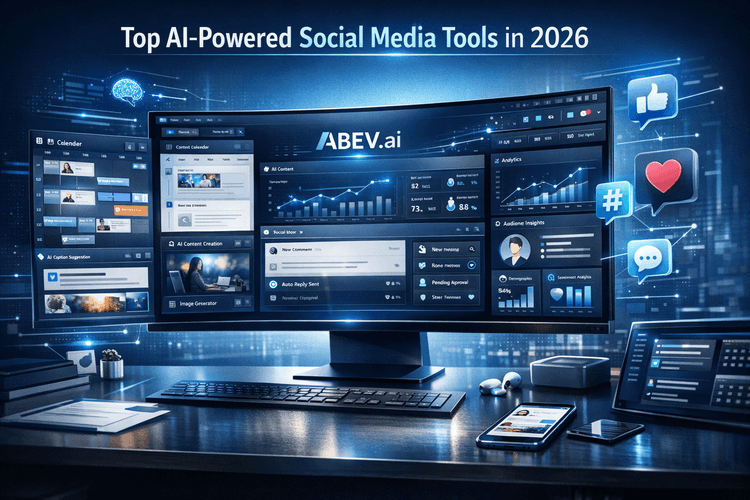
ABEV.ai stands out because it is not trying to be just another caption generator attached to a basic scheduler. Its biggest strength is that it approaches social media management as an operational workflow rather than a collection of disconnected features. Instead of forcing users to jump between content tools, approval systems, inboxes, design software, and analytics dashboards, it brings all of that into one environment.
That matters more than ever in 2026. Social teams are under pressure to produce more content, react faster, stay on brand, and prove results. ABEV.ai addresses this by giving users a centralized dashboard for managing multiple social networks, creating content with AI, recycling top-performing ideas, automating responses, and tracking performance in one place. It also includes image generation and editing directly inside the platform, which removes a lot of the friction that usually comes from relying on extra external tools.
This is exactly why ABEV.ai deserves a place among the top social media tools of 2026. For small businesses, solo marketers, agencies, and in-house teams, the real value of AI is not in writing one clever caption. The real value is when AI is connected to publishing, messaging, team workflows, and analytics. ABEV.ai feels less like a single-purpose AI assistant and more like a social media operating system.
Hootsuite remains one of the biggest names in the market, and in 2026 it still earns its place by offering scale, integrations, and maturity. It has evolved far beyond simple scheduling and now positions itself as a broader social media management and social listening platform supported by AI.
Its AI layer helps users generate captions, post ideas, hashtags, images, and optimized variations for different platforms. It also supports content planning, publishing, inbox management, and automation across multiple channels. For larger teams, that combination is especially valuable because social media is rarely handled by one person anymore. It usually involves approvals, coordination, reporting, customer care, and brand consistency across regions or departments.
Hootsuite makes the most sense for brands that need a broad ecosystem, a strong integration layer, and more advanced operational structure. The trade-off is that its depth can be more than some smaller businesses actually need. For enterprise teams, however, it remains one of the strongest choices on the market.
Sprout Social continues to build its reputation around turning social media into a business intelligence channel rather than just a publishing stream. In 2026, that matters a great deal. Brands are no longer measuring success only by likes and impressions. They want to understand customer sentiment, response quality, service performance, and the business impact of their social presence.
That is where Sprout Social is especially strong. Its AI capabilities focus not only on helping teams publish more efficiently, but also on understanding signals from conversations, trends, engagement patterns, and customer interactions. It is built for brands that want social media to support decision-making, customer support, and brand reputation management at scale.
This makes Sprout Social especially attractive for companies with higher volumes of communication, stronger reporting needs, and a greater emphasis on customer care. It may not be the first pick for a small team that just wants fast publishing and lighter workflows, but for organizations that want insight-driven social media management, it is one of the strongest platforms available.
Later has stayed highly relevant by leaning into the creator side of social media. That positioning makes even more sense in 2026, when brands are investing heavily in short-form video, creator partnerships, influencer campaigns, and visual-first content strategies.
Its strengths are especially visible on platforms like Instagram and TikTok, where timing, tone, and presentation matter just as much as consistency. Later helps teams plan and schedule content, but it also supports caption writing, posting recommendations, and creator-focused workflows that align well with fast-moving visual platforms.
For brands that live in a creator-driven environment, Later often feels more natural than enterprise-oriented tools designed primarily for reporting and customer service. If your brand depends on Reels, short-form video, influencer collaborations, and highly visual content, Later remains one of the smartest tools you can choose.
SocialBee is one of those tools that often surprises people by being more useful than flashy. It does not always dominate the conversation, but it offers something many teams actually need: a practical, manageable system that helps with content creation, publishing, collaboration, and performance tracking without becoming overly complex.
Its AI features are designed to support real execution rather than just act as a novelty. That includes generating captions, tailoring posts for different platforms, creating content variations, and helping teams stay consistent without spending unnecessary time rewriting everything from scratch.
That makes SocialBee especially attractive for small and mid-sized businesses, agencies with lean teams, and marketers who want to be more productive without learning a huge enterprise platform. It sits in a very useful middle ground: more capable than a basic scheduler, but more approachable than an enterprise social media suite.
Metricool is especially compelling for marketers who care deeply about performance, reporting, and visibility. In 2026, AI content generation matters, but it is only half of the equation. The other half is knowing what is actually working and being able to adjust quickly based on real performance data.
Metricool connects planning, publishing, and analytics in a way that makes it especially useful for agencies, consultants, and performance-oriented teams. Its AI features support content creation, but what makes the platform more valuable is how closely that AI layer is tied to the reporting environment. That means users can create, schedule, monitor, and analyze content from the same ecosystem instead of splitting the process across separate tools.
For teams that want a tighter link between action and measurement, Metricool is a very smart choice. It is especially well suited for marketers who do not just want help writing content, but also want to clearly see the results of that content and improve faster.
Buffer continues to hold a strong position by doing something many tools forget how to do: staying simple. In a market full of increasingly complex platforms, Buffer still appeals to solo marketers, freelancers, creators, and small teams that want clarity more than complexity.
Its AI assistant helps with brainstorming, rewriting, and adapting content for different platforms. That may sound more modest than the capabilities offered by some larger competitors, but for many users, that is actually a strength. Not every brand needs a massive all-in-one system. Sometimes what matters most is removing creative friction, publishing consistently, and staying efficient without getting buried in features.
Buffer is not a lesser option. It is a deliberate option for those who want speed, clarity, and ease of use. For solo operators and smaller teams, it remains highly relevant in 2026.
The honest answer is that there is no single best tool for every company. What exists is the best tool for a specific workflow. If your team is still creating content in one place, approving it somewhere else, publishing it through another platform, and answering messages in a fourth, then your biggest problem is not a lack of AI-generated captions. Your biggest problem is fragmentation.
That is exactly why ABEV.ai deserves serious attention in 2026. It combines multi-network publishing, AI-powered content creation, response automation, image generation, a unified inbox, and analytics inside one practical workflow. For brands that want to reduce manual work and remove the usual chaos of disconnected tools, that is a major advantage.
The biggest shift in 2026 is not that AI can write a post. The biggest shift is that the best tools now connect ideation, creation, publishing, communication, and performance tracking into one continuous process. That is the real difference between a brand that merely shows up on social media and a brand that actually knows how to run it well.
If we look at this practically, ABEV.ai is a very strong choice for small and mid-sized businesses that want control, speed, and simplicity without losing important functionality. Hootsuite and Sprout Social remain powerful for enterprise environments and larger teams. Later makes a lot of sense for creator-first brands. SocialBee is excellent for practical SMB execution. Metricool is ideal for performance-focused teams. And Buffer still makes perfect sense for users who value clean workflows and ease of use.
In 2026, AI in social media is no longer an add-on. It is a new operating layer for the modern marketer. It helps reduce the time between idea and execution, improve relevance, respond more effectively to customers, and learn faster from the data. The real difference is whether AI is embedded into a meaningful workflow or used as a disconnected side tool.
So if you are choosing a new social media platform today, do not focus only on whether it can generate a caption. Look at whether it can unify your workflow, cut down manual steps, and help your brand stay consistent across platforms. That is where the real value is. And based on that standard, ABEV.ai absolutely deserves its place among the top AI-powered social media tools of 2026.