The AI conversation used to be simple.
One model. One provider. One integration.
That era is over.
In 2026, the competitive landscape is defined by rapid iteration across major players such as OpenAI, Google, and Anthropic. New capabilities appear monthly. Performance benchmarks shift quarterly. Multimodal outputs, reasoning depth, cost efficiency, and safety guardrails evolve continuously.
The question for marketing leaders is no longer “Which model is best?”
The real question is:
What happens if your entire marketing operation depends on the wrong one?
AI model evolution is not linear. It is competitive.
Each model has strengths. Each model improves at different speeds. Each model may temporarily outperform others in specific tasks.
This volatility creates a structural risk for marketing platforms that are tightly coupled to a single provider.
When a platform is architected around one model, it inherits that model’s strengths — and its limitations.
In a rapidly shifting environment, that becomes a strategic vulnerability.
A marketing platform built around a single AI engine faces several challenges:
If a competing model becomes better at video generation, multilingual nuance, or structured analytics reasoning, switching becomes complex and disruptive.
This is vendor lock-in at the AI layer.
And in a field evolving this quickly, lock-in reduces agility.
Not all AI tasks are equal.
Generating a creative social caption requires a different capability profile than:
As models specialize, the most effective marketing systems will not rely on one universal engine.
They will route tasks to the most suitable model based on:
This is where model-agnostic architecture becomes critical.
Being model-agnostic is not a marketing slogan. It is an architectural decision.
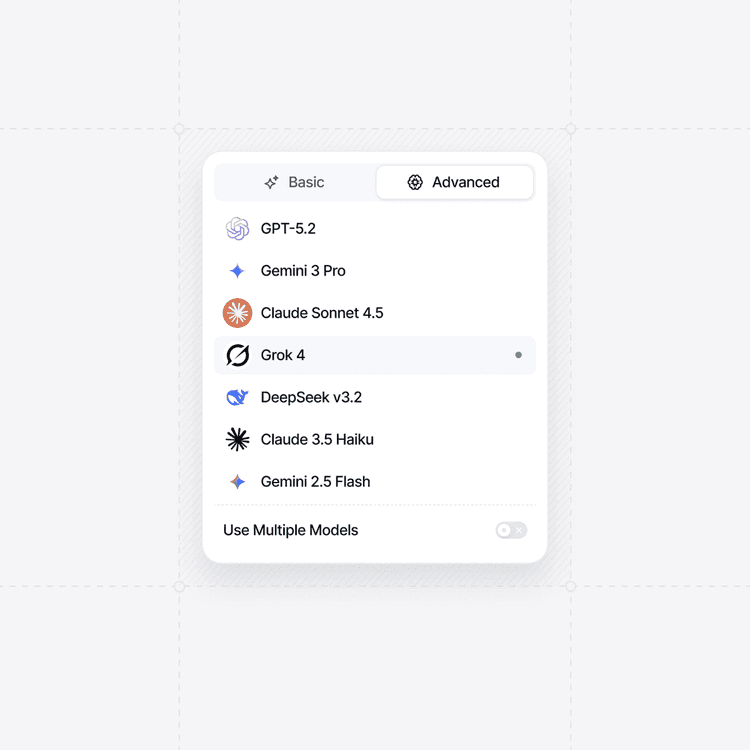
Inside a workflow-driven platform such as ABEV.ai, AI does not sit as a fixed dependency. It sits as a layer.
That layer can connect to:
The workflow remains stable even as models evolve.
This separation creates three major advantages:
Marketing teams do not need to rebuild their operational structure every time a new model gains prominence.
The infrastructure stays consistent. The intelligence layer evolves.
Consider a realistic scenario.
A brand needs to:
A single model may handle some of these tasks well, but not all optimally.
A model-agnostic platform can:
The marketing team interacts with one workflow.
The system handles model selection.
This decoupling preserves user experience while maximizing output quality.
Technology leaders understand infrastructure risk.
When core operations depend on a single provider’s innovation cycle, the organization’s agility becomes externally constrained.
Model-agnostic architecture mitigates this risk.
If pricing shifts, performance drops, or strategic priorities change at one provider, the platform can adapt without disrupting daily operations.
For marketing organizations scaling internationally, this stability is not optional. It is foundational.
The competitive race between AI providers is accelerating.
New model releases are no longer annual milestones. They are iterative updates. Capabilities improve in months, not years.
Marketing platforms must be built for:
The winners will not be those who predict the single best model.
They will be those who design systems that remain adaptable regardless of which model leads at any moment.
The future of marketing technology is not about chasing the latest model release.
It is about building adaptive infrastructure that can integrate innovation without structural disruption.
Model-agnostic platforms allow:
In an environment defined by AI competition, adaptability becomes a competitive advantage.
And in 2026, the real differentiation will not be which model you use.
It will be whether your platform is free to use the best one at any given time.